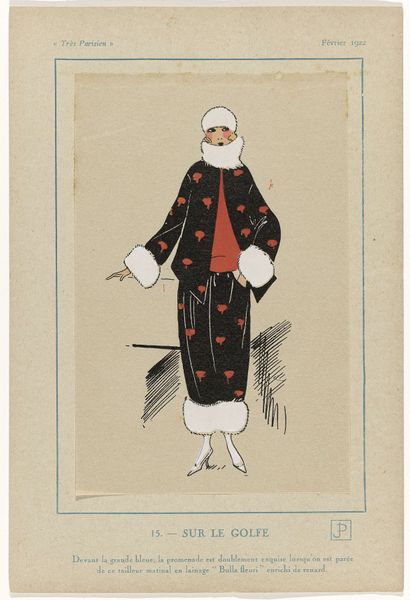
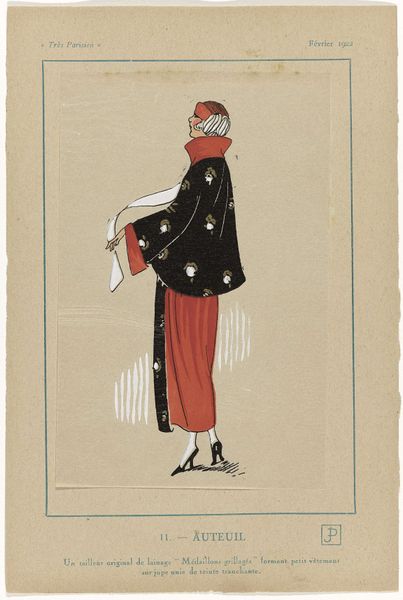
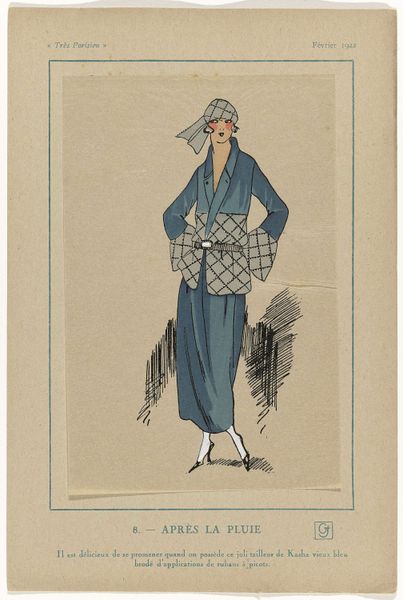
Gazette du Bon Ton, 1914 - No. 7, Pl. 68: Le paysage romantique / Costume tailleur de Worth 1914
0:00
0:00

Dimensions: height 247 mm, width 193 mm
Copyright: Rijks Museum: Open Domain
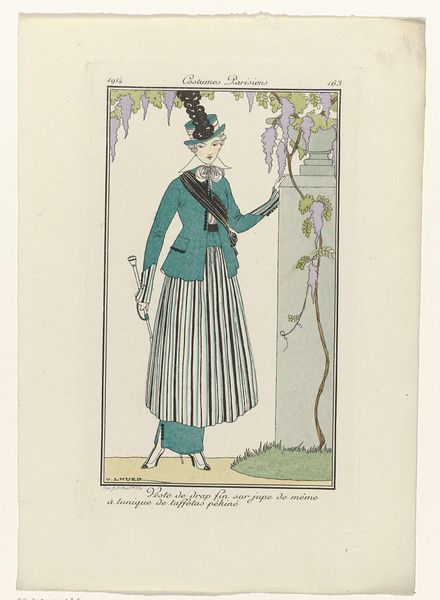
Curator: Gazette du Bon Ton, 1914 - No. 7, Pl. 68: Le paysage romantique / Costume tailleur de Worth by Bernard Boutet de Monvel, created as a drawing. The drawing has a quiet sense of nostalgia for me. What are your initial thoughts on this piece? Editor: It's beautiful, I agree, and evokes an elegant calmness! The subject is, nominally, a fashionable woman, but what do you see in this that I may have missed? Curator: Let’s focus on the context. The “Gazette du Bon Ton” was a high-end magazine, a consumable object itself, showcasing luxury goods during a time of immense social change on the eve of World War I. Notice how the woman's clothing, a 'tailleur' or tailored suit by Worth, isn't just presented as an aesthetic object, but connected with the broader landscape—suggesting leisure, wealth, and a certain ideal of French life. Does the setting enhance or detract from the reading of fashion? Editor: The landscape, which is part of the design, is beautifully Impressionistic, so I see both the lady and the landscape as intrinsically part of the "merchandise", designed to sell lifestyle rather than just the clothing itself. And yet it feels quite static...almost frozen. Is it about promoting a status? Curator: Precisely! How is status represented here, visually? Consider the labor involved. The quality of paper, printing and ink, and the dress making process would not be readily available for a lot of society. So there is that tension: art illustrating commodity intended for consumption by the elite. A lifestyle of consumption presented as high art. Do you see how the materiality elevates the status? Editor: Yes, I see that the quality of material says 'status', not just 'fashion'. I’m also noting the 'ordinariness' of the garment itself, since it is a practical suit! Curator: Yes, a paradox indeed. Seeing the details like this helps better understand how wealth pervades what is presented to the viewer in the piece. Editor: Thanks! Looking closely at the materials used, and the context it was created for, gives us a different angle from which to understand the design.
Comments
No comments
Be the first to comment and join the conversation on the ultimate creative platform.
 Collect
 React
React Comment
More like this