1697
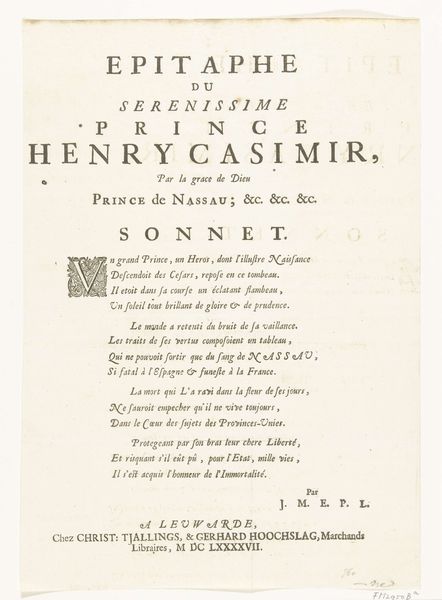
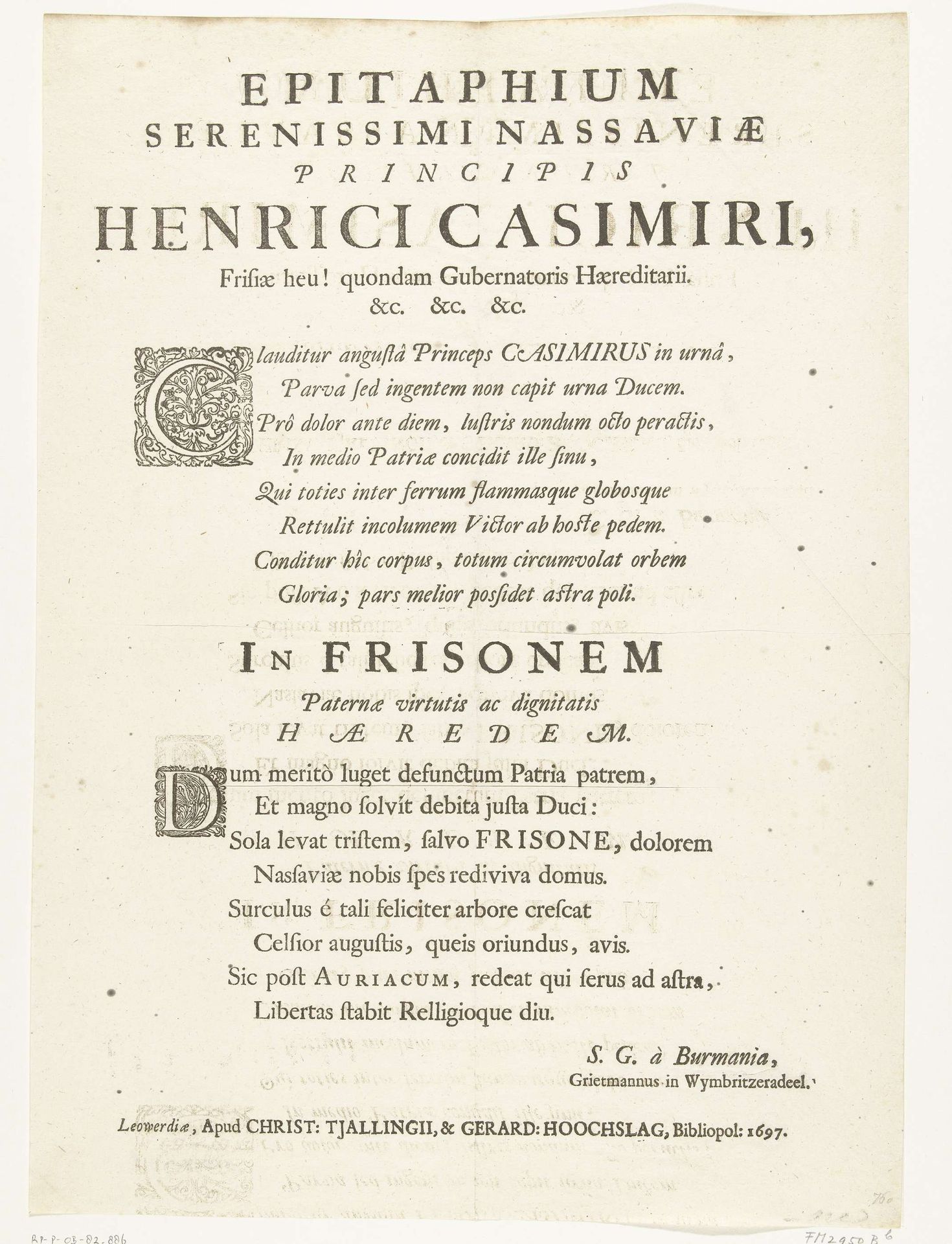
Epitaaf voor Hendrik Casimir II, graaf van Nassau-Dietz, 1697

Listen to curator's interpretation
Curatorial notes
Curator: Here, we have an engraved print, titled "Epitaaf voor Hendrik Casimir II, graaf van Nassau-Dietz, 1697," created in 1697. At first glance, what are your immediate thoughts? Editor: Striking. There is a solemn quality, almost austere, in the careful arrangement of type. I notice how the dark, precise lines of the lettering create a visual rhythm across the page. I also see the scale; the intimate, handheld nature of the piece suggests a personal rather than a monumental expression of grief. Curator: Indeed. Its visual construction, through typography and engraving, elevates it beyond a simple textual announcement. Note the framing and layout, which work to emphasize symmetry and balance—aspects indicative of Baroque sensibilities in memorial art. Editor: Speaking of labor, consider the painstaking craft involved. Each letter, each flourish, is incised by hand. What tools and materials enabled such precision, and what level of skill was required? I also think about how this object would be circulated. Its accessibility points toward a deliberate attempt to disseminate both grief and political messaging, especially since the Nassau-Dietz family were a culturally influential part of the Dutch Stadtholder system. Curator: Excellent points. The text, written in Latin, is carefully divided into sections, further enriching the composition. The initial letters C and D contain spiraling, detailed vegetal ornamentation—echoes of the deceased’s natural origins rendered into idealized abstractions. Editor: So, the physical act of creating and distributing such a piece – the economics and the craft involved – they also play a role in constructing memory, as much as the visual composition. These factors become more transparent the more we examine the conditions of its production. Curator: A fitting tribute for its time. It synthesizes the weight of history and power through calculated design, with Baroque ideals ever present. Editor: And now, seeing the material reality – how it's made, by whom, and why it was so important to communicate— we understand how much these conditions shape the very narratives around that power.