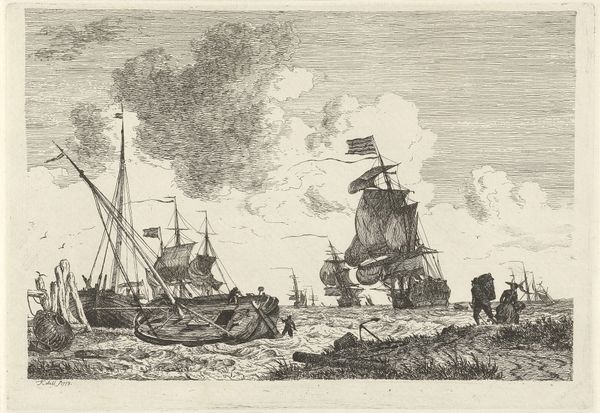
Dimensions: height 51 mm, width 47 mm
Copyright: Rijks Museum: Open Domain
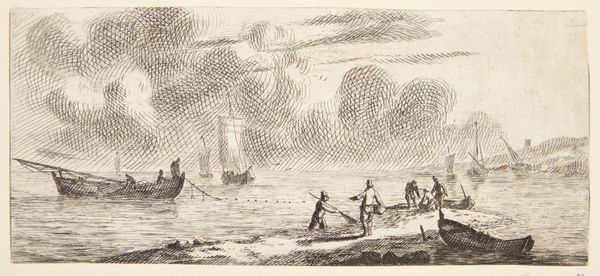
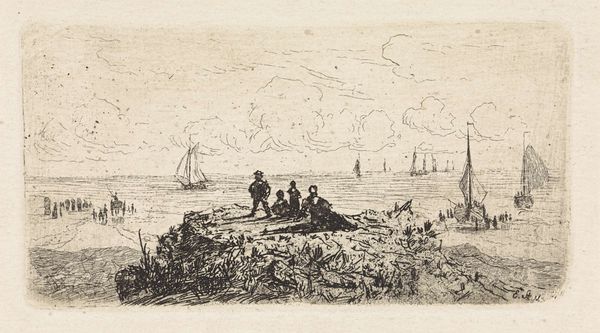
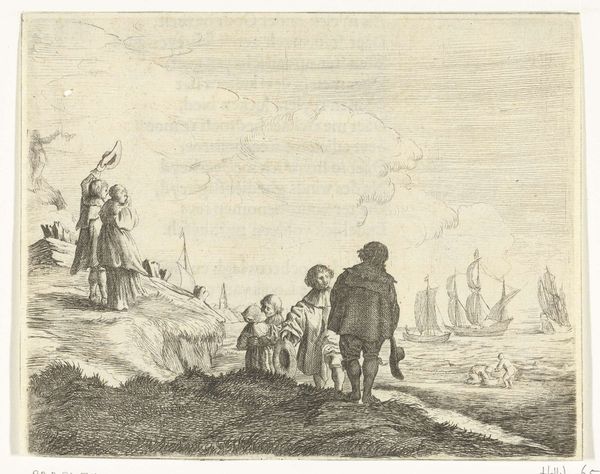
Curator: Immediately, I’m drawn to the figures in the foreground—their posture suggests labor, but also a sense of communal rest. Editor: This is "Fishermen by the Beach," an etching by Hendrik Kobell from 1777, held here at the Rijksmuseum. It depicts a coastal scene with figures engaged in fishing activities. The materiality of etching here, the thin lines on paper, contrasts the social and material realities of 18th-century fishermen’s lives. Curator: The choice of etching lends itself to this slightly bleak Romanticism, wouldn’t you agree? What strikes me are the heavy lines around the figures. It's almost as if Kobell is highlighting their forms through the sheer physical effort it must have taken to create that detailing on the copper plate. Editor: Indeed, and that's what I see also—how the artist shapes perception of work through distribution and sale in the art market. The "genre painting" style suggests this work was intended for a specific audience with money, who romanticized labour as aesthetic objects for leisure, to consume this scene and the figures as they consume resources obtained via labor in their own society. Curator: It is a compelling commentary, presented via what we can only assume was, for Kobell, a meticulous process. I think of the role galleries like this play in constructing such narratives. By showing Kobell’s piece in a space dedicated to art, it allows visitors to connect that romantic view of work on the coastline to what it signifies across many contexts. Editor: And think how social dynamics play out not just on canvas, but also around production practices. Printmaking allowed wider, potentially lower-class access to images—but access still defined by purchasing power, privilege to engage leisure, education, gallery visiting, etc.. Curator: Exactly. By analyzing the labor, skill, and intended market for this work, we also see labor as it changes. It is removed further and further from the raw work done on the coast here, filtered instead through etching lines on metal. Editor: Right, considering art's relationship with wider culture helps us recognize the politics embedded within its beauty. A lovely summation.
Comments
No comments
Be the first to comment and join the conversation on the ultimate creative platform.
 Collect
 React
React Comment
More like this