drawing, ink, poster
#
drawing
#
ink drawing
#
narrative-art
#
figuration
#
text
#
ink
#
symbolism
#
poster
Copyright: Public domain
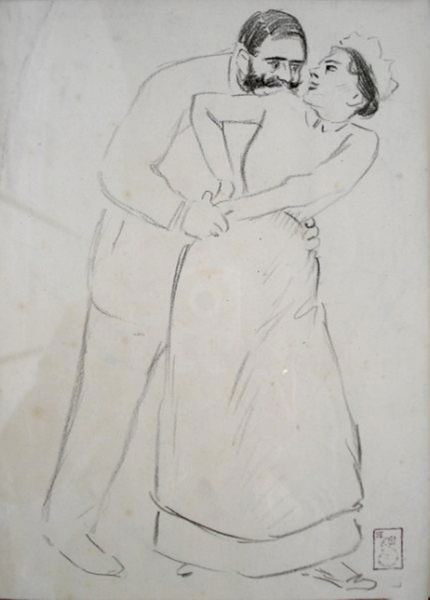
Curator: Here we have Théophile Alexandre Steinlen’s striking ink drawing, "La Chanson de la Vie," dating back to 1894. The Song of Life, a curious title. Editor: Indeed. My first impression? Eerie and touching. It's a spectral dance between mortality and innocence, a rather grim waltz of sorts. Curator: Precisely. Note how Steinlen uses simple ink strokes to create such a powerful visual statement. The skeletal figure, so sharply defined against the softer, rounder baby. Editor: The contrast is stark, literally! A skeleton in a suit cradling an infant; it’s an old trope, death holding life. I find the semiotic implications rather heavy-handed. Curator: Perhaps, but consider the cultural context of 19th century Paris. Symbolism was in full swing. Life's fragility, the ever-present shadow of mortality… Steinlen captures this mood effectively. Also note how his background as a poster artist adds another layer. The title is worked into the composition, and every line conveys his narrative in a manner easily accessible even for a fleeting passerby on the streets of Montmartre. Editor: Good point on accessibility. But for me, it's the line work itself, that hasty almost careless stroke, that captures the chaotic blend of terror and hope. A sense of the inevitable mixed with a dose of gentle reassurance that something, however small, always begins. Curator: Right. The gestural quality humanizes an otherwise bleak tableau. Editor: Definitely. So, not just about death lurking in life, but life fearlessly blooming even in the arms of death. Curator: Beautifully put. There's a poignant defiance in that image, an ode to the cyclical nature of things, wouldn’t you agree? It's kind of… life-affirming. Editor: In a darkly humorous, Symbolist kind of way, yes. It's a piece that keeps me thinking, and feeling. I guess, after all, art can make life that bit more interesting, despite everything.
Comments
No comments
Be the first to comment and join the conversation on the ultimate creative platform.
 Collect
 React
React Comment
More like this