graphic-art, print, woodcut
#
graphic-art
# print
#
landscape
#
figuration
#
expressionism
#
woodcut
#
line
Dimensions: height 248 mm, width 327 mm
Copyright: Rijks Museum: Open Domain
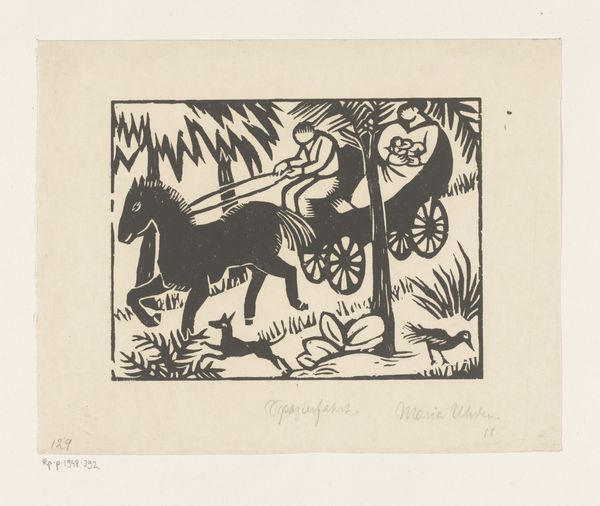
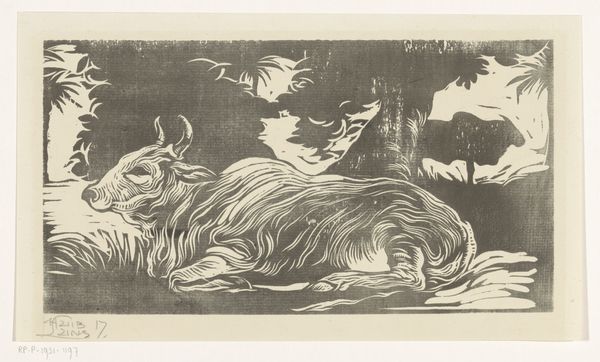
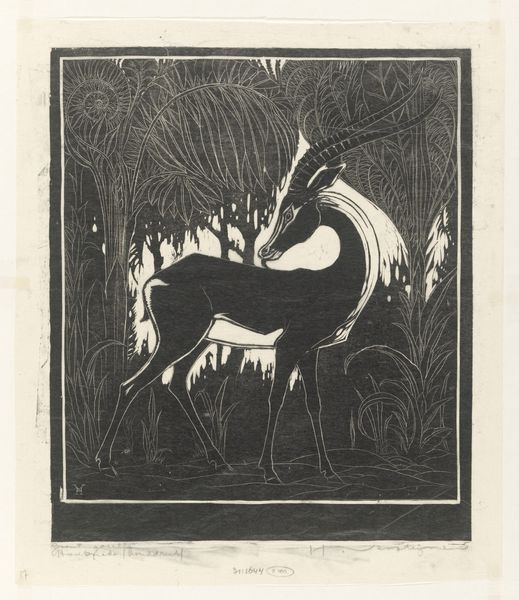
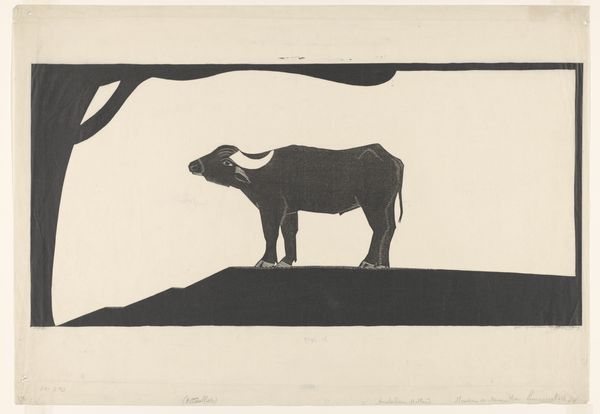
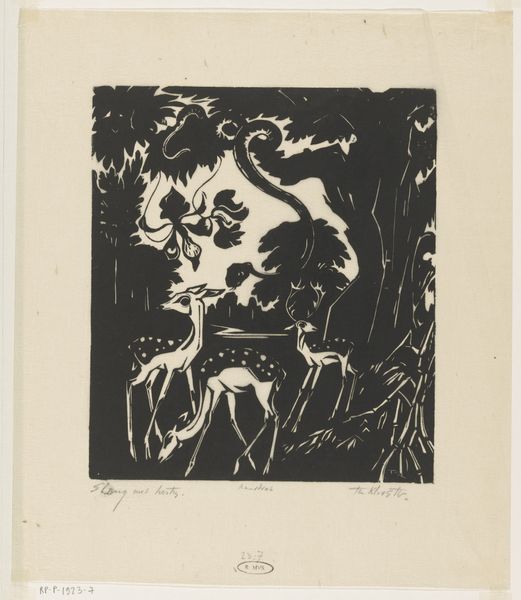
Editor: Here we have Bernard Essers' "Two Cows by a Tree," a woodcut print from around 1925. The strong contrast immediately jumps out; it feels both pastoral and intensely graphic at the same time. How do you interpret the cultural meaning in such a stylized rendering of, well, cows? Curator: It’s interesting that you key into the graphic quality. Considering this was made around 1925, a time when printmaking was gaining popularity, partly because of its accessibility as a medium but also as a form of social commentary, I wonder how Essers saw the role of the pastoral within a rapidly changing world. What did the imagery of cows evoke then? Was it simply nostalgic? Editor: Nostalgia? Perhaps. Though, the Expressionist style lends an edge that moves beyond sentimentality, doesn't it? The high contrast, the starkness… it almost feels critical of rural life. Curator: Exactly. Instead of a sweet pastoral scene, the sharp lines and almost harsh black and white could be highlighting the economic realities of farming or even a subtle commentary on the idealization of the rural versus the urban. Consider who would have been viewing this; likely, it would be shown in urban galleries and homes, providing a perspective removed from the actual work depicted. Do you think this distance informs the print’s reception? Editor: Absolutely! It creates a dialogue between the viewer's expectation and the actual representation. It’s a push and pull, a negotiation of values. I had thought of it as a fairly simple landscape but it becomes a much more nuanced statement. Curator: And that's often where the true value of art lies: in its ability to speak to the complex relationship between representation, context, and the viewer's own socio-political reality. I think exploring the context of production and display of an image is essential for truly grasping the depth.
Comments
No comments
Be the first to comment and join the conversation on the ultimate creative platform.
 Collect
 React
React Comment
More like this