1920s
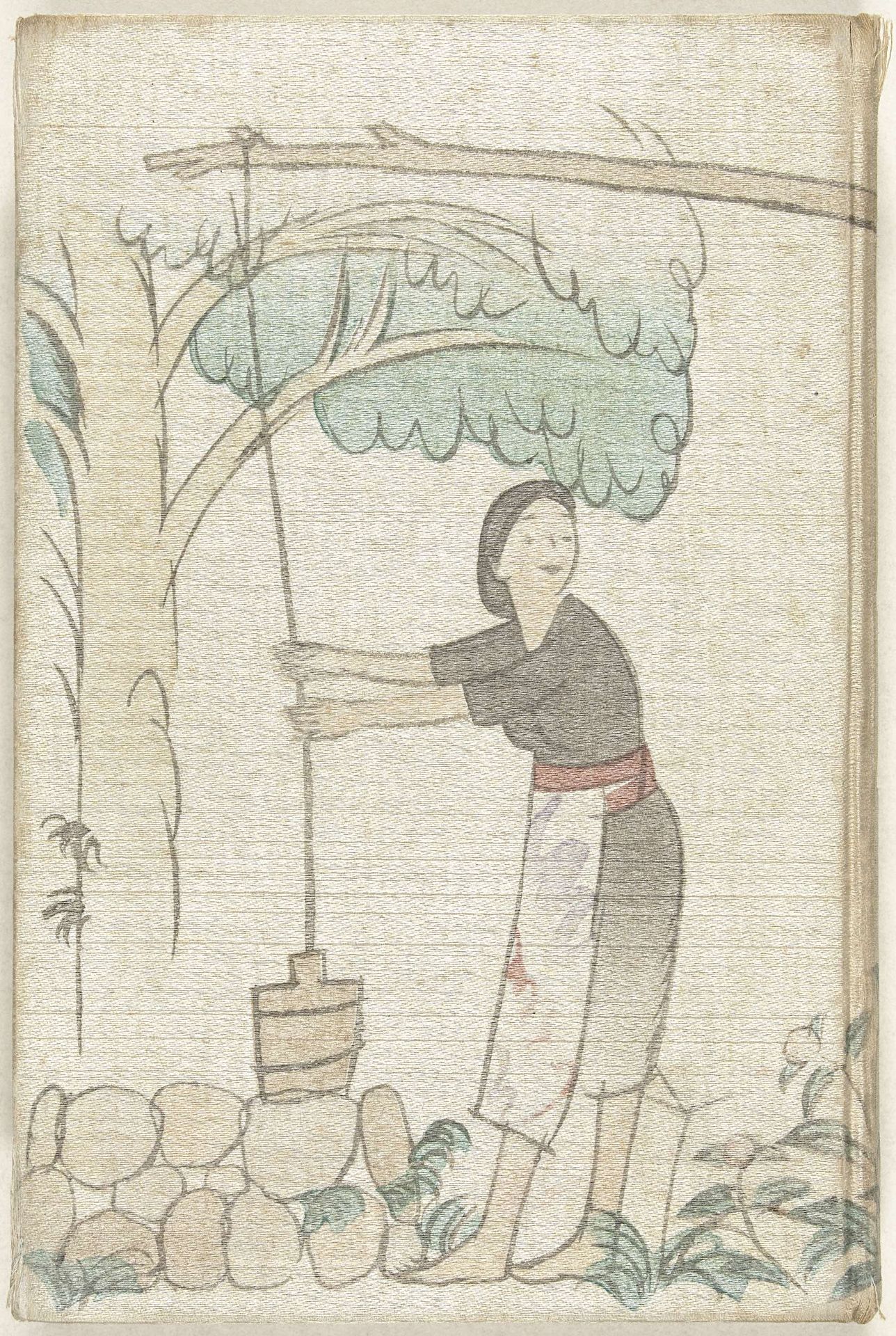
De inwoners en vegetatie van Musashino

Ôta Saburô
1884 - 1969Location
RijksmuseumListen to curator's interpretation
Curatorial notes
Curator: This watercolor and colored pencil work is entitled “The Inhabitants and Vegetation of Musashino” and it was created in the 1920s by Ōta Saburō. You can find it here at the Rijksmuseum. Editor: Hmm, peaceful. It’s a humble scene—a woman drawing water. Makes you think about simple routines, everyday existence. I wonder what her story is. Curator: Note the emphasis on line; contours delineate forms and convey spatial relationships, establishing structure in the representation of both the figure and the surrounding environment. The subdued color palette contributes to a sense of visual harmony, wouldn't you agree? Editor: Totally, it's delicate! Those pastel tones—the pale blues and greens—give it an almost dreamlike quality. Not quite realistic, you know? More about capturing a mood than photographic accuracy. The textures too are subtle. I want to touch it. Curator: And observe how Ōta employs flattened perspective, minimizing depth to draw attention to the compositional arrangement on the surface plane. The materials, watercolour and coloured pencil, facilitate a particular lightness and translucency. Editor: Right, I'm into that. I love that the perspective’s a bit skewed—gives the piece this childlike charm. I see what you mean about the arrangement too—it leads my eye. All these subtle colors kinda calm you. Almost like looking into the past, a glimpse of another time. It's like remembering a memory...but someone else's. Curator: A sophisticated reading. In summary, “The Inhabitants and Vegetation of Musashino” stands as a compelling study of representation, engaging with the visual language of early 20th-century Japanese art and its interplay with tradition and modernity. Editor: Yeah, seeing this work…it makes me want to slow down and watch someone go about their ordinary life, like, really watch them. Soak it up. There’s beauty even in the simplest acts, and this piece does that—holds that truth for us.