

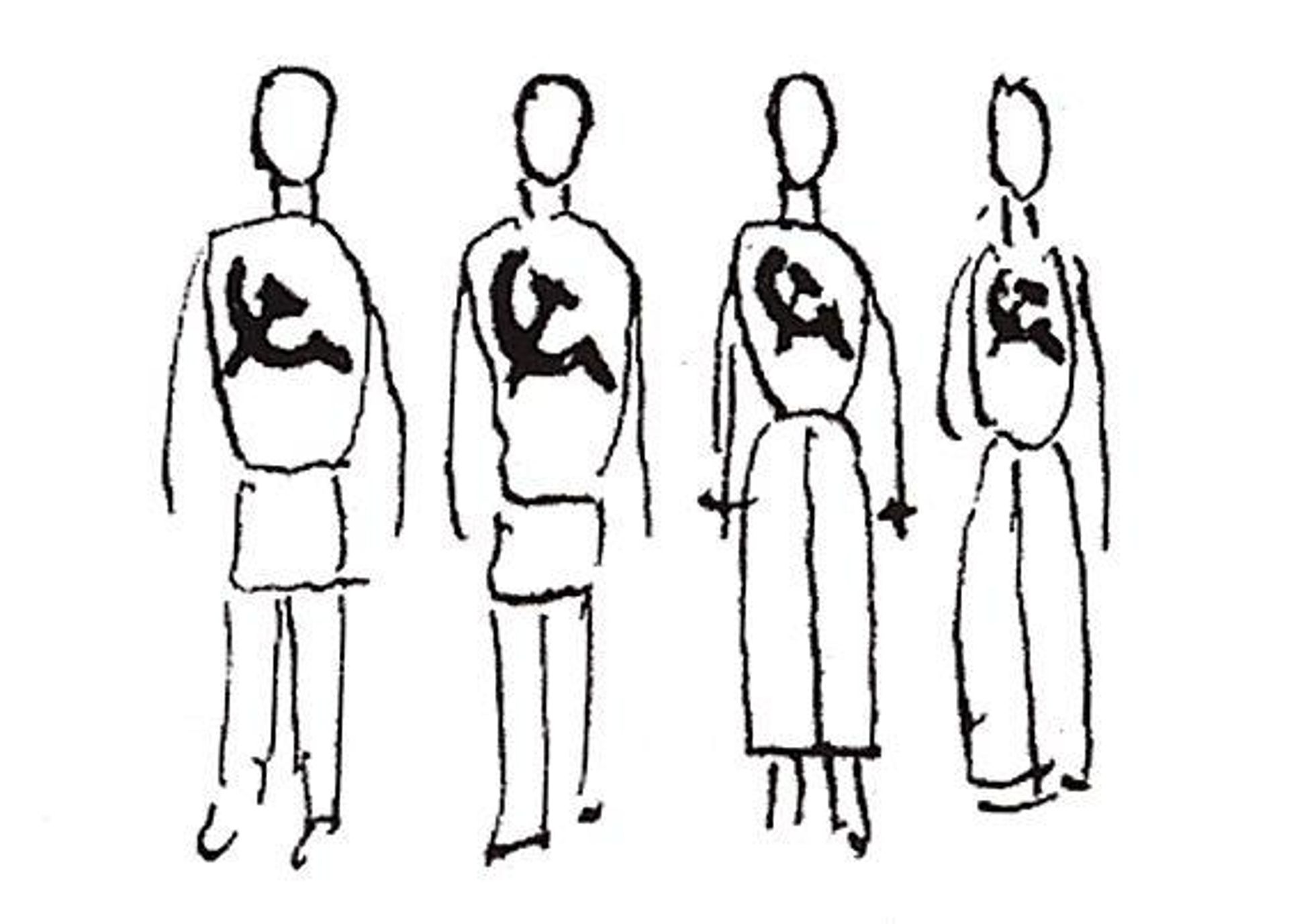
Four pieces with a the hammer and sickle

Listen to curator's interpretation
Curatorial notes
Curator: This is "Four Pieces with a Hammer and Sickle" by Kazimir Malevich, an intriguing work with no precise dating. What catches your eye immediately? Editor: The starkness. Four figures, drawn with such simple, almost brutal lines, immediately evokes a sense of the utilitarian and the monumental, all at once. And it's just a drawing! What more can you tell me? Curator: Well, looking at the method and form, the drawing, presumably with ink or charcoal, emphasizes line over volume. We see an engagement with figuration, but a clear leaning into Soviet nonconformist artistic ideals. The simplification of form brings forward an interesting perspective. The making of this drawing involved basic materials to potentially address the common person. Editor: Absolutely. The hammer and sickle emblazoned on each figure, like a uniform, speaks directly to the political climate. What was Malevich trying to say? Curator: Malevich’s placement of these figures, uniform yet individualized through subtle variations in dress and posture, may have been his method of publicly processing complex societal ideals through readily available materials and basic drawing tools. His labor emphasizes his ideas about class, representation and power within social structures. Editor: The choice to use such raw, almost hurried lines… was it a commentary on the pace of change during the revolution, maybe the mass production expected of the era, visualized? The speed with which things were supposed to be manufactured? Curator: That’s astute. Perhaps it's the making of this work that allows him to insert meaning: the drawing, not as finished work of fine art but a process, perhaps a template. We have the social expectation of an image— the symbolic imagery of propaganda — distilled down to something almost basic, almost primordial. What are the ramifications of this symbol divorced from its typical method of conveyance? Editor: For me, I can’t ignore that the images on these figures flatten them—depersonalizes them in a way that the quick line work also reflects. Considering that Malevich became persona non grata for some time after his revolutionary painting, I am moved by how his own institutional trajectory shapes how he could depict this ideology. The drawing gives the art a voice with its visual and critical analysis. Curator: An appropriate ending to a quick moment of considering Malevich’s hand through a close-up drawing. Editor: Yes, looking at the hand in terms of production opens all sorts of possibilities for discussion.