About this artwork
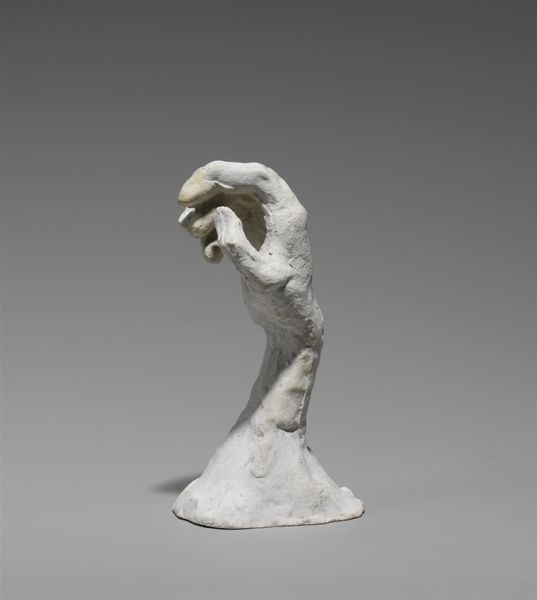
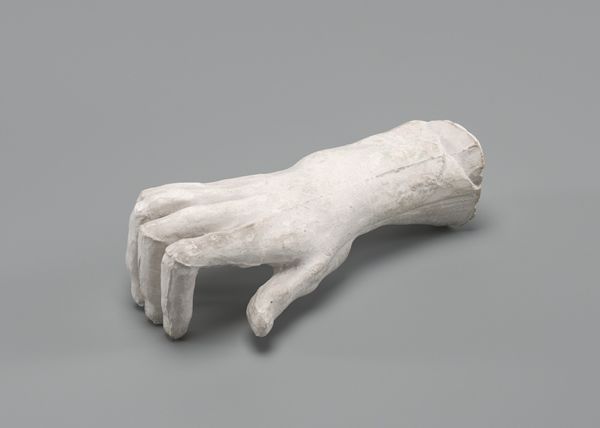
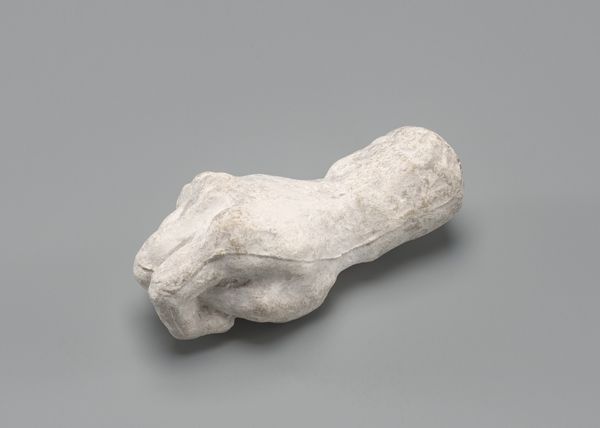
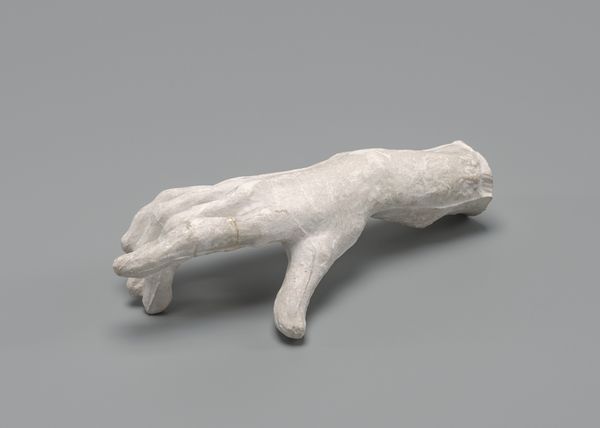
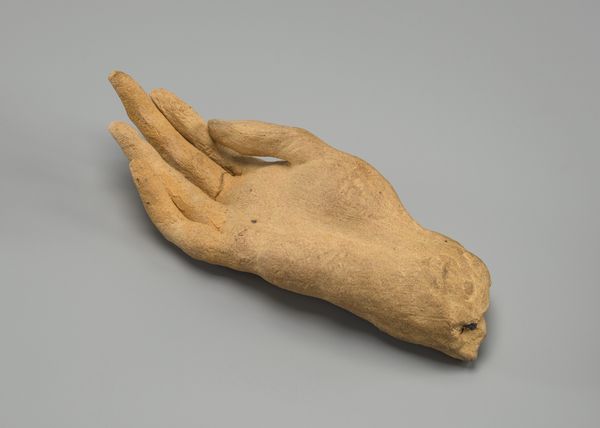
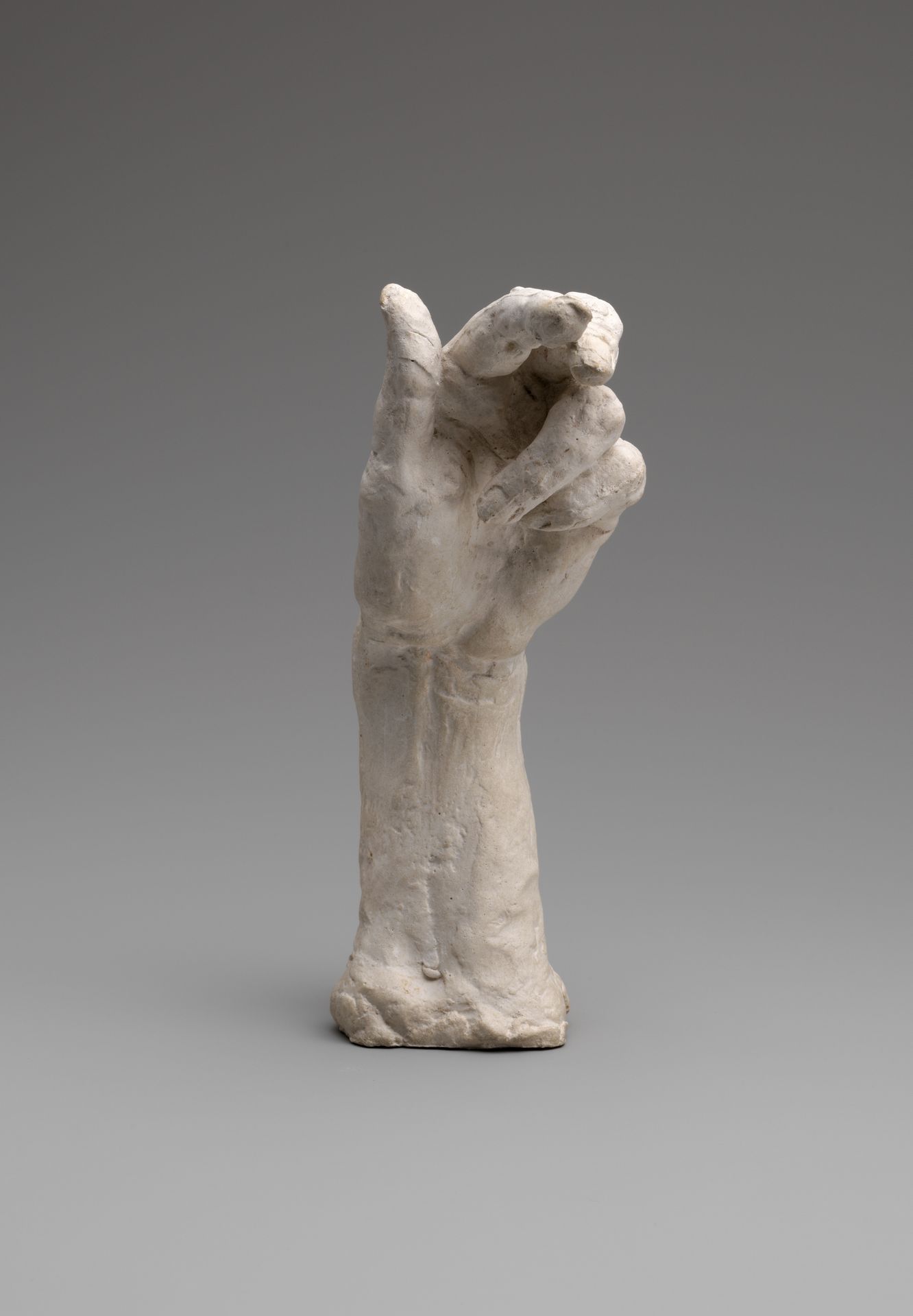
Curator: We are looking at "Study of a Hand" by Auguste Rodin, a bronze sculpture currently housed in the Metropolitan Museum of Art. Editor: Its scale strikes me immediately. There’s a fragmentariness to it; it feels monumental despite, or perhaps because of, being only a part. Curator: Hands, in Rodin's practice, become these concentrated sites of meaning, even operating independently of a larger figure. Think of the hand as an instrument, the seat of action and intention. Editor: True, it has a tactile quality almost urging one to read its semiotics; it isn't simply a depiction of flesh and bone, but instead a lexicon of form. Look how Rodin coaxes movement from the rigid medium through sharp contrasts of shadow and light. Curator: Precisely! Rodin imbued it with psychological depth; notice the somewhat clenched pose. A slight tension suggesting restrained power, maybe even suppressed emotion. Editor: A micro-drama encapsulated in a single form. Considering its incompleteness and monochromatic nature, what symbolical load does it convey beyond the surface realism? Curator: The fragmented nature hints at a focus on process over the definitive. A constant negotiation of possibilities rather than settled conclusions about being human. It’s meant for continuous probing. Editor: Perhaps that is why this Study of a Hand resonates so strongly with modern sensibilities. It rejects totalization and fixed meaning, it favors contingency and nuanced complexity instead. Curator: Definitely! An emblem that leaves so much open to conjecture reminds us about our potential and freedom to craft meaning continuously in our surroundings. Editor: Indeed. I came in ready to scrutinize composition and form, and walked away considering questions of power and purpose!
Study of a hand
0-0


Artwork details
- Medium
- bronze, sculpture
- Dimensions
- 6 3/8 × 2 1/2 × 3 3/4 in. (16.2 × 6.4 × 9.5 cm)
- Location
- Metropolitan Museum of Art, New York, NY
- Copyright
- Public Domain
Tags
Comments
Share your thoughts
About this artwork
Curator: We are looking at "Study of a Hand" by Auguste Rodin, a bronze sculpture currently housed in the Metropolitan Museum of Art. Editor: Its scale strikes me immediately. There’s a fragmentariness to it; it feels monumental despite, or perhaps because of, being only a part. Curator: Hands, in Rodin's practice, become these concentrated sites of meaning, even operating independently of a larger figure. Think of the hand as an instrument, the seat of action and intention. Editor: True, it has a tactile quality almost urging one to read its semiotics; it isn't simply a depiction of flesh and bone, but instead a lexicon of form. Look how Rodin coaxes movement from the rigid medium through sharp contrasts of shadow and light. Curator: Precisely! Rodin imbued it with psychological depth; notice the somewhat clenched pose. A slight tension suggesting restrained power, maybe even suppressed emotion. Editor: A micro-drama encapsulated in a single form. Considering its incompleteness and monochromatic nature, what symbolical load does it convey beyond the surface realism? Curator: The fragmented nature hints at a focus on process over the definitive. A constant negotiation of possibilities rather than settled conclusions about being human. It’s meant for continuous probing. Editor: Perhaps that is why this Study of a Hand resonates so strongly with modern sensibilities. It rejects totalization and fixed meaning, it favors contingency and nuanced complexity instead. Curator: Definitely! An emblem that leaves so much open to conjecture reminds us about our potential and freedom to craft meaning continuously in our surroundings. Editor: Indeed. I came in ready to scrutinize composition and form, and walked away considering questions of power and purpose!
Comments
Share your thoughts