painting, watercolor
#
painting
#
war
#
landscape
#
figuration
#
oil painting
#
watercolor
#
vanitas
#
romanticism
#
history-painting
Copyright: Public Domain: Artvee
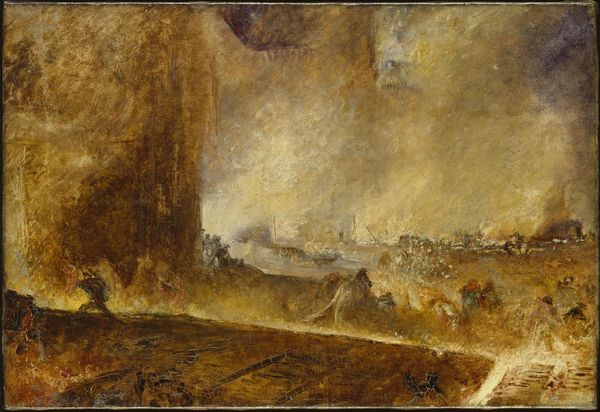
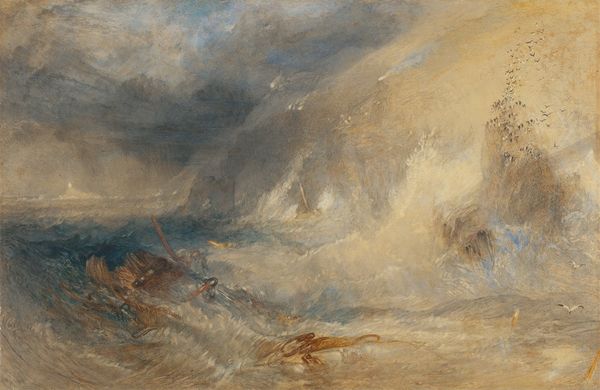
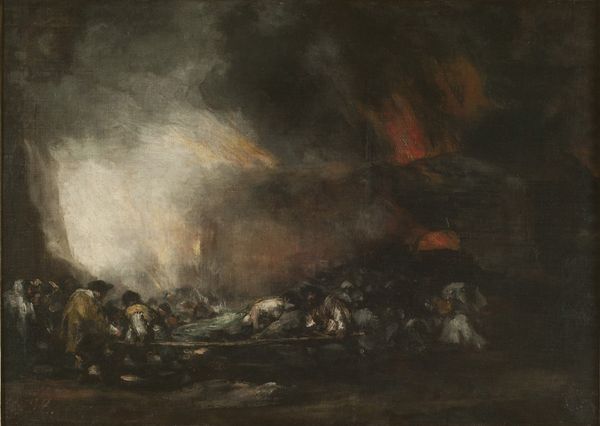
Curator: J.M.W. Turner's "The Field of Waterloo Seen From Hougoumont" presents a scene heavy with the aftermath of battle. What strikes you initially? Editor: An overwhelming sense of desolation. The composition is divided almost violently, sky versus earth, blue fading into reds of destruction. It's spatially jarring, making the human forms seem like insignificant debris. Curator: Observe how Turner juxtaposes the carnage of the foreground with the atmospheric rendering of the sky and distant landscape. This isn’t a depiction celebrating victory but rather, through expressive washes, emphasizes the sheer devastation and emotional residue of the event. Turner was, in essence, critiquing history painting itself. Editor: Precisely. It disrupts any conventional glorification. We see discarded implements of war scattered amidst fallen bodies, painted with a lack of heroic detail. This deliberate flatness could be a statement against the romanticizing narratives often associated with conflict. The burning buildings are equally crucial, representing structures of power reduced to mere fuel for the inferno. Curator: The medium is also key here. Watercolor possesses a transparency, a fluidity mirroring the transient nature of life and glory. It avoids the weighty monumentality typical of history paintings, instead favoring ephemerality to underscore loss and futility. Note how forms bleed into one another, mirroring the blurred line between victor and vanquished. Editor: And perhaps that sense of blending implies complicity, questioning the grand narratives we construct about warfare. It also encourages contemplation about institutional responsibility concerning collective suffering, doesn’t it? Curator: Undeniably. What may at first glance appear as an artistic portrayal of the famous battle becomes a potent reflection upon the deeper ethical implications of violence. Editor: The absence of valor, the emphasis on human cost...Turner offers a powerful and quite disturbing counternarrative. Curator: It's a somber reminder. We've explored a fascinating paradox here, using artistic methods to critique the very concepts they often celebrate.
Comments
No comments
Be the first to comment and join the conversation on the ultimate creative platform.
 Collect
 React
React Comment
More like this