

before 1886
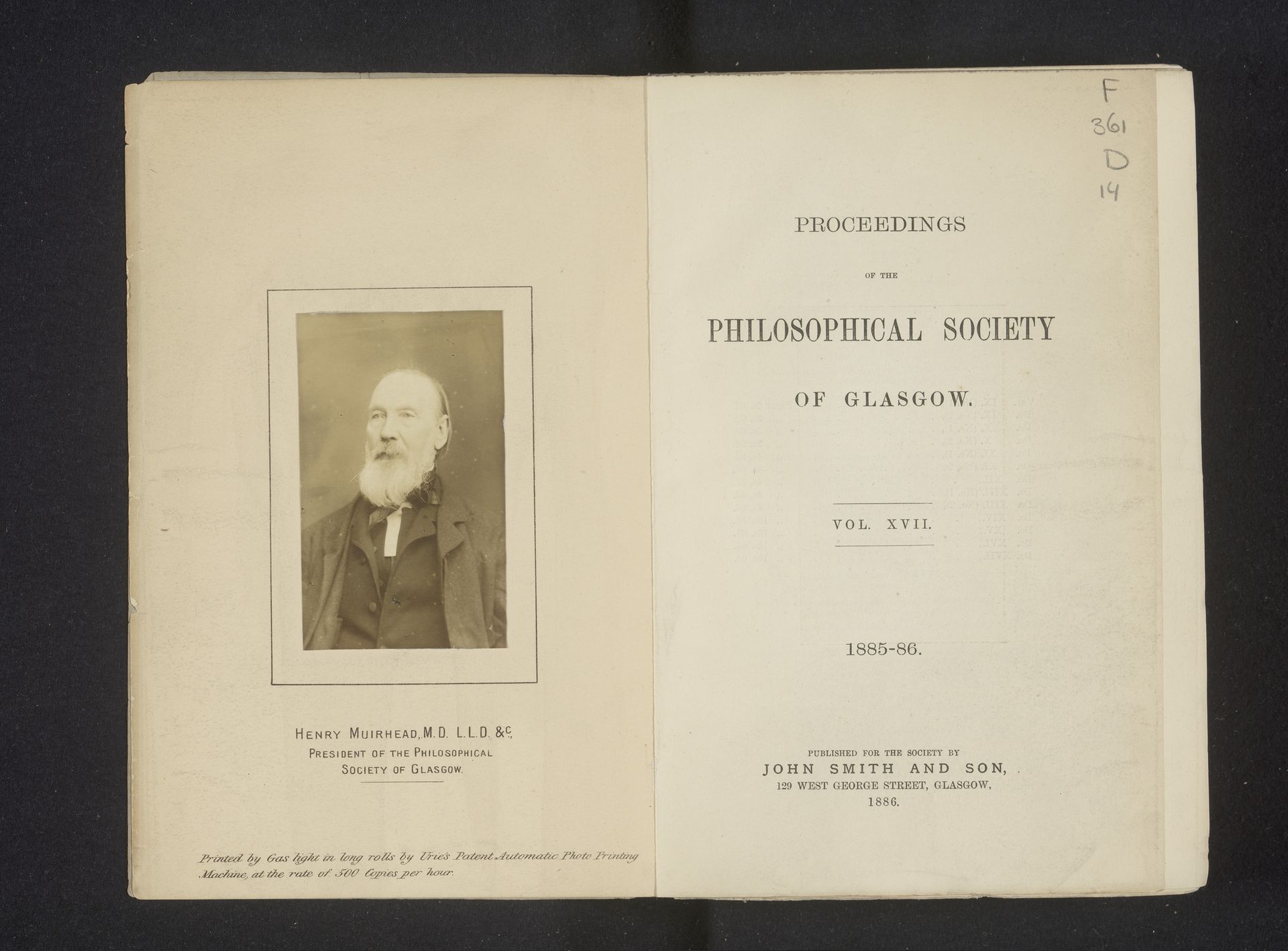
Portret van John Henry Muirhead

Listen to curator's interpretation
Curatorial notes
Curator: Before us, we have "Portret van John Henry Muirhead," a photograph featured in the "Proceedings of the Philosophical Society of Glasgow" dating from before 1886. Editor: Immediately, I’m struck by the contrast between the crisp photographic portrait and the stark typography on the facing page. There’s a stillness to Muirhead's gaze that feels almost sculptural. Curator: Yes, the formal composition creates a powerful focal point. The framing of Muirhead’s face, enclosed within its own border on the larger page, establishes a visual hierarchy. The greyscale tones enhance the feeling of profound gravity. Editor: Seeing this publication tells us much about the philosophical circles of Glasgow. This photographic portrait signals a certain level of public and intellectual visibility for Muirhead within this community. Its inclusion as part of printed academic proceedings underlines the way photography was used in legitimising academic figures. Curator: We cannot ignore the printing process. Consider the textures involved – the paper itself, the ink laid down via a fast rotary press capable of 500 prints per hour! The visual hierarchy, too, isn’t merely representational, it’s functional – guiding the eye through information presented as much text as image. Editor: This print also shows something interesting in terms of portraiture becoming an accessible medium for commemorating leaders within civic society at the end of the 19th century. Think about how the Philosophical Society of Glasgow were trying to position themselves through visual rhetoric. Curator: Indeed, the success lies in the carefully calculated balance between representation and its function. Editor: Examining the visual economy tells a broader social and cultural narrative. The portrait helps humanize abstract ideas. Curator: I agree; and for me, deconstructing the visual weight allows us to see the power of form. It's the image-text interplay that gives the work such resonance. Editor: This reminds us that visual representation has never been politically neutral, right down to who has the power to frame whose face!