painting, plein-air, watercolor
#
painting
#
impressionism
#
plein-air
#
landscape
#
river
#
impressionist landscape
#
watercolor
#
natural-landscape
#
water
#
nature
#
watercolor
Copyright: Public domain
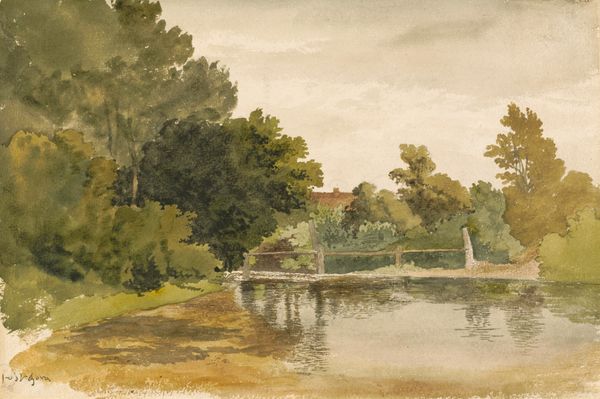
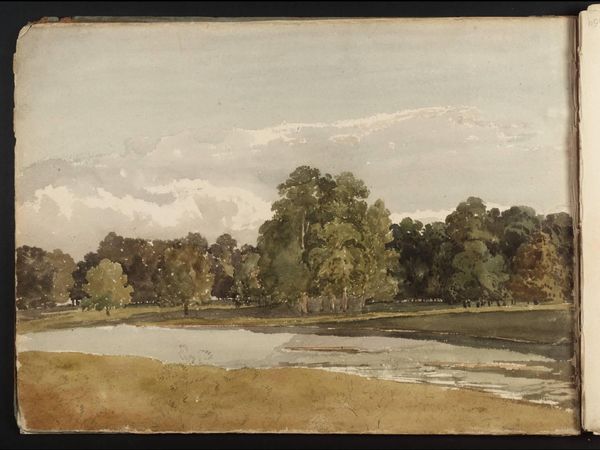
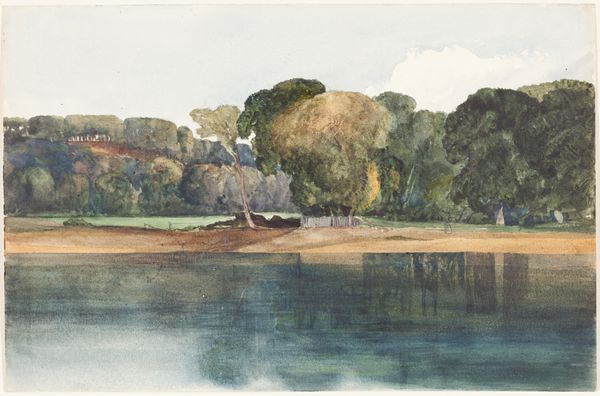
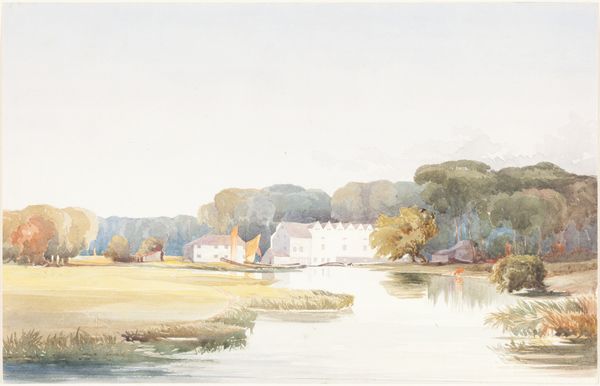
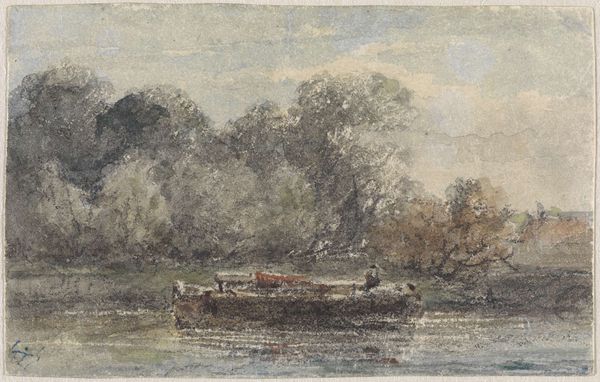
Editor: This watercolor, "Study of Landscape in Richmond," created by Anders Zorn in 1882, is quite lovely. There's a sense of tranquility, almost stillness, evoked by the water and the hazy sky. What stands out to me is the way Zorn uses such loose brushstrokes, especially in the reflections on the water. How do you interpret the artist's technique in conveying a sense of place here? Curator: Focusing on its formal elements, observe how Zorn constructs depth through layering translucent washes of color. Notice the strategic placement of darker green hues to define the treeline and foreground, creating a spatial recession. The horizontal composition reinforces the stillness you mentioned, further emphasizing the materiality of the watercolor medium itself, exploiting its inherent fluidity. Editor: The looseness makes it feel very immediate, like a snapshot in time. Is that a function of it being painted "en plein air?" Curator: Indeed. The immediacy arises precisely from that direct engagement with the landscape, but we must acknowledge that "en plein air" is a conceptual choice which speaks directly to Impressionist notions of capturing transient effects. Notice how Zorn limits his palette, using mainly greens, blues, and browns, yet achieves a remarkable luminosity. What compositional strategies enable that visual effect? Editor: Perhaps the contrast between the darker greens in the trees and the lighter sky creates that contrast and enhances the atmospheric effect. Curator: Precisely. Furthermore, consider how the thinness of the paint, allowing the paper to show through, adds to the sense of light and airiness, exemplifying the beauty inherent to the medium and elevating the atmospheric effect of the painting. Editor: This exploration has made me more aware of Zorn's artistic choices and how the technical properties are part of how the overall visual structure emerges. Curator: And in turn, this awareness helps to solidify how we might explore and investigate a piece through the careful lens of a formal analysis.
Comments
No comments
Be the first to comment and join the conversation on the ultimate creative platform.
 Collect
 React
React Comment
More like this