

1775
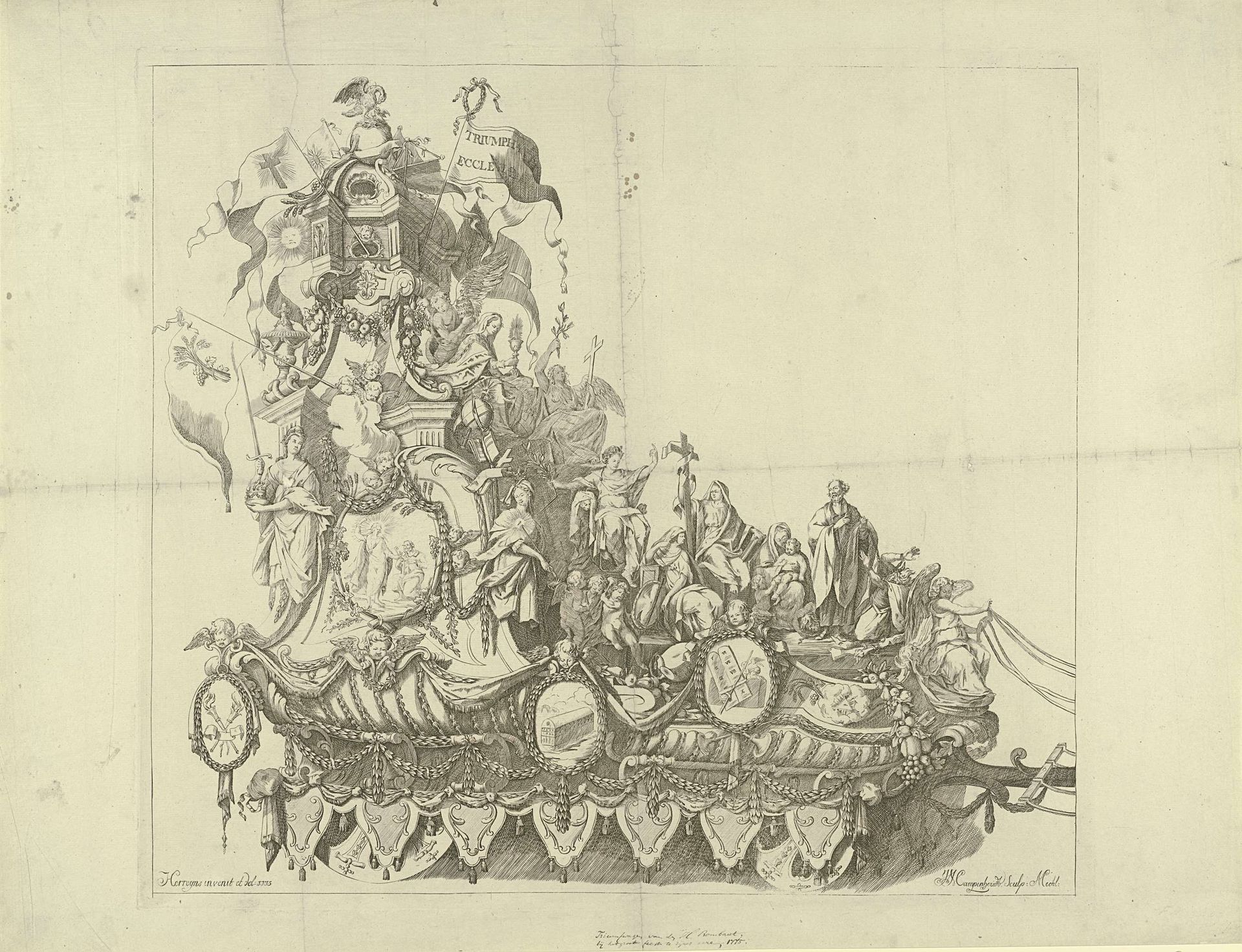
Triomfwagen bij het 1000-jarig feest van de H. Rombout, 1775

Listen to curator's interpretation
Curatorial notes
Curator: What strikes me first is how incredibly ornate this whole thing is. It feels…like a fever dream of baroque celebration. Editor: That’s an interesting way to put it. We're looking at "Triomfwagen bij het 1000-jarig feest van de H. Rombout, 1775," a drawing in ink, pen, and engraving by Jan Jacob van Campenhoudt. It commemorates the millennial feast of Saint Rombout. It really is overflowing with symbolism and historical figures, isn’t it? Curator: Overflowing is an understatement! Look at the sheer density of figures piled onto what I presume is the triumphal cart. Angels, banners, geometric motifs. It almost feels overwhelming to the eye. It makes me think about the use of history-painting to reflect on religious authority at that time. How would that resonate, I wonder? Editor: Absolutely, that’s very astute. It certainly plays into the Baroque aesthetic of grandiosity and spectacle, intending to inspire awe and perhaps reinforce social hierarchies, I think. There's so much line work, and considering it’s pen and ink, the detail is just astounding. It reminds me a little of stage design or the detailed preparatory drawings architects would have made. Do you find that too? Curator: Definitely, like a blueprint for an enormous event or performance! I would bet this drawing acts as a window into understanding societal values and religious veneration in 18th-century Brabant. I would ask, how were marginalized voices represented—or more likely, silenced—in these grand narratives? Editor: Exactly. I can see your critical thinking at work. Even visually, the way the lines dance and weave together…it evokes a sense of constant movement, a procession frozen in time. For me, the skill behind rendering so much detail does reflect devotional energy... almost meditative for the artist? What do you reckon? Curator: Interesting thought. Yes, the act of creation must've demanded significant focus. But also, who commissioned this work, and for what specific audience? Power dynamics, as ever, are key. I feel you can also reflect, what's Saint Rombout legacy, if it wasn't built on equality for everyone? Editor: You certainly provided great food for thought. I look at it again and appreciate its texture and chaotic celebration—a testament to another time. Curator: Agreed. By contextualizing artwork through social analysis, that gives the present opportunity to assess these values from a critical point of view. It does allow me to connect with this piece.