drawing, print, engraving
#
drawing
#
allegory
#
baroque
# print
#
history-painting
#
engraving
#
angel
Dimensions: sheet: 14 1/16 x 9 3/4 in. (35.7 x 24.7 cm)
Copyright: Public Domain
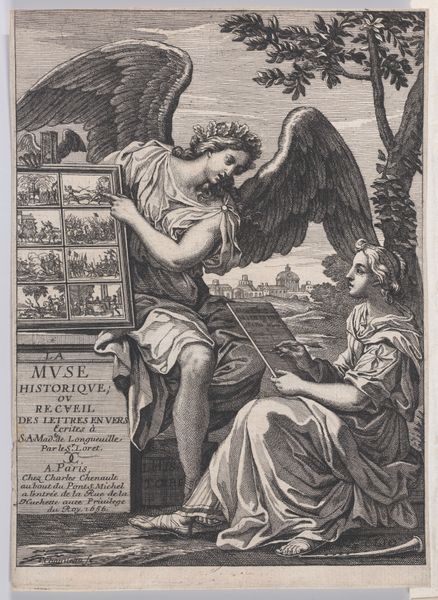
Curator: This engraving, titled "Frontispiece for New Testament in Greek," was created in 1642 by Claude Mellan. Editor: It immediately strikes me as a curious blend of monumentality and lightness, with that obelisk juxtaposed against the almost saccharine putti. Curator: Mellan, a master of the Baroque style, utilizes the engraving medium to explore themes of religious allegory and history-painting. Note how he renders the texture of the stone surfaces versus the feathery wings and draped cloth. Editor: Yes, the contrast is stark. The Old Testament panel appears rigid and burdened, in contrast to the ethereal New Testament, as if the law itself were giving way to a different paradigm. I am immediately reminded of the complex, religiously fraught political landscape in seventeenth-century Europe. This frontispiece serves almost as propaganda, promoting specific ideological positions during a period of profound religious division and conflict. Curator: Consider also Mellan's intricate rendering of form through varied line weights and densities, creating a tonal range that's quite remarkable for a line engraving. The artist really does make this incredibly intricate use of hatching. Editor: The artist clearly attempts to create the visual metaphor of supplantation. Is this perhaps even about the dominance of the printing press as a mechanism for religious interpretation in this period? Curator: The composition certainly invites that reading. The text "EK BAΣIΛIKHΣ TYΠOΓPAΦAΣ," visible at the bottom of the image, connects it directly to a royal printing house. The work isn’t just a religious frontispiece, it is making a grand claim of institutional religious imprimatur. Editor: Absolutely. By linking the image so explicitly to a printing house, Mellan, intentionally or not, puts questions of power, translation, and dissemination squarely at the heart of how we're invited to approach these scriptures. Curator: Indeed, an exercise in complex communication through sophisticated means. The Baroque penchant for combining emotion and depth with structure is masterfully realized. Editor: I think I leave seeing the piece in conversation with Europe’s own deep historical fractures around sacred knowledge, translation, and visibility of both print and religion.
Comments
No comments
Be the first to comment and join the conversation on the ultimate creative platform.
 Collect
 React
React Comment
More like this