print, engraving
# print
#
landscape
#
romanticism
#
genre-painting
#
engraving
Dimensions: height 276 mm, width 371 mm
Copyright: Rijks Museum: Open Domain
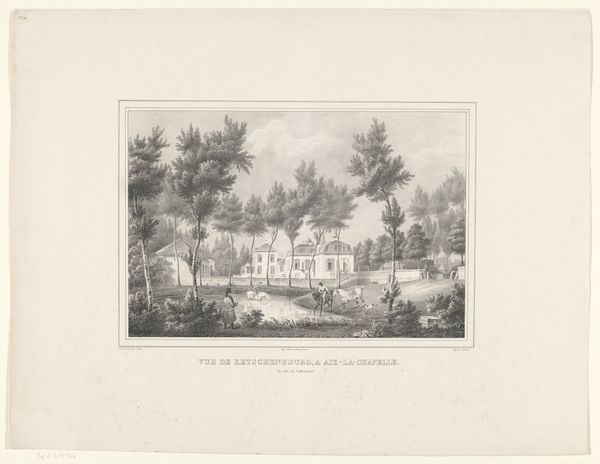
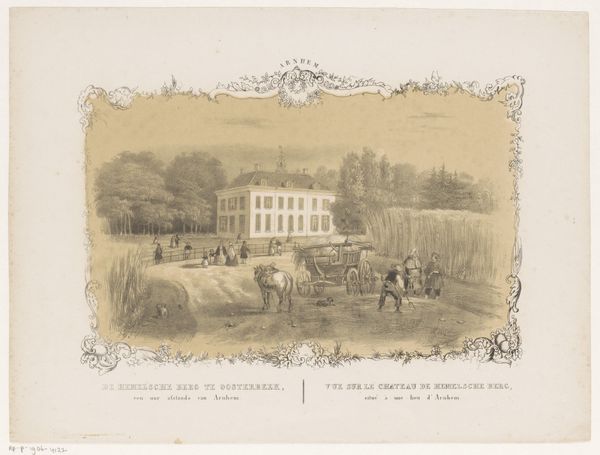
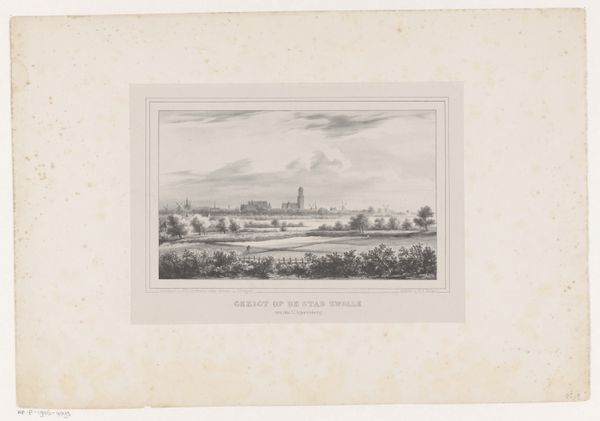
Curator: This print, "Recreanten langs de oever van de Rijn" by Hendrik Wilhelmus Last, created around 1850, showcases a leisurely scene along the Rhine. The delicate lines of the engraving depict figures enjoying the landscape. What are your initial impressions? Editor: I notice the ornate border around the image; it's very detailed and frames the central scene effectively. There's almost a sense of calm despite the activity, but how much does the medium inform this print? Curator: Excellent observation. Consider how the artist employs line and form. The delicate hatching creates subtle tonal gradations. Look at the contrast between the meticulously rendered figures in the foreground and the more generalized background. Does the very nature of engraving – its linear precision – shape the overall impression? Editor: I hadn’t thought about the medium like that. It gives a clear, almost idealized feel, but it's also limited, wouldn't you agree? Is that an intentional choice or an aesthetic constraint? Curator: Precisely. The linearity enhances the romanticized vision. The arrangement of forms, from the figures clustered near the 'hotel' to the winding river, creates a carefully constructed visual order. Note also how light is managed: a diffuse glow softens edges, but details remain crisp. Is light purely representational here, or does it perform a more structural role, guiding our eye? Editor: I see how the light separates the areas of action, creating zones of interest within the landscape. The composition draws me into the distant view after focusing on the foreground figures. Curator: Notice, as well, that it employs semiotic components with that landscape/scenery. How the structure and balance of this composition influence our interpretation of 1850 leisure is essential for interpreting works. Editor: I’ve never thought about that when analysing art before! I can apply semiotic and visual markers of identity through these cues. It will inform all my study in the future. Curator: It certainly makes you think about what art tells us and how to decode it effectively using theory and detailed visual assessment!
Comments
No comments
Be the first to comment and join the conversation on the ultimate creative platform.
 Collect
 React
React Comment
More like this