1723
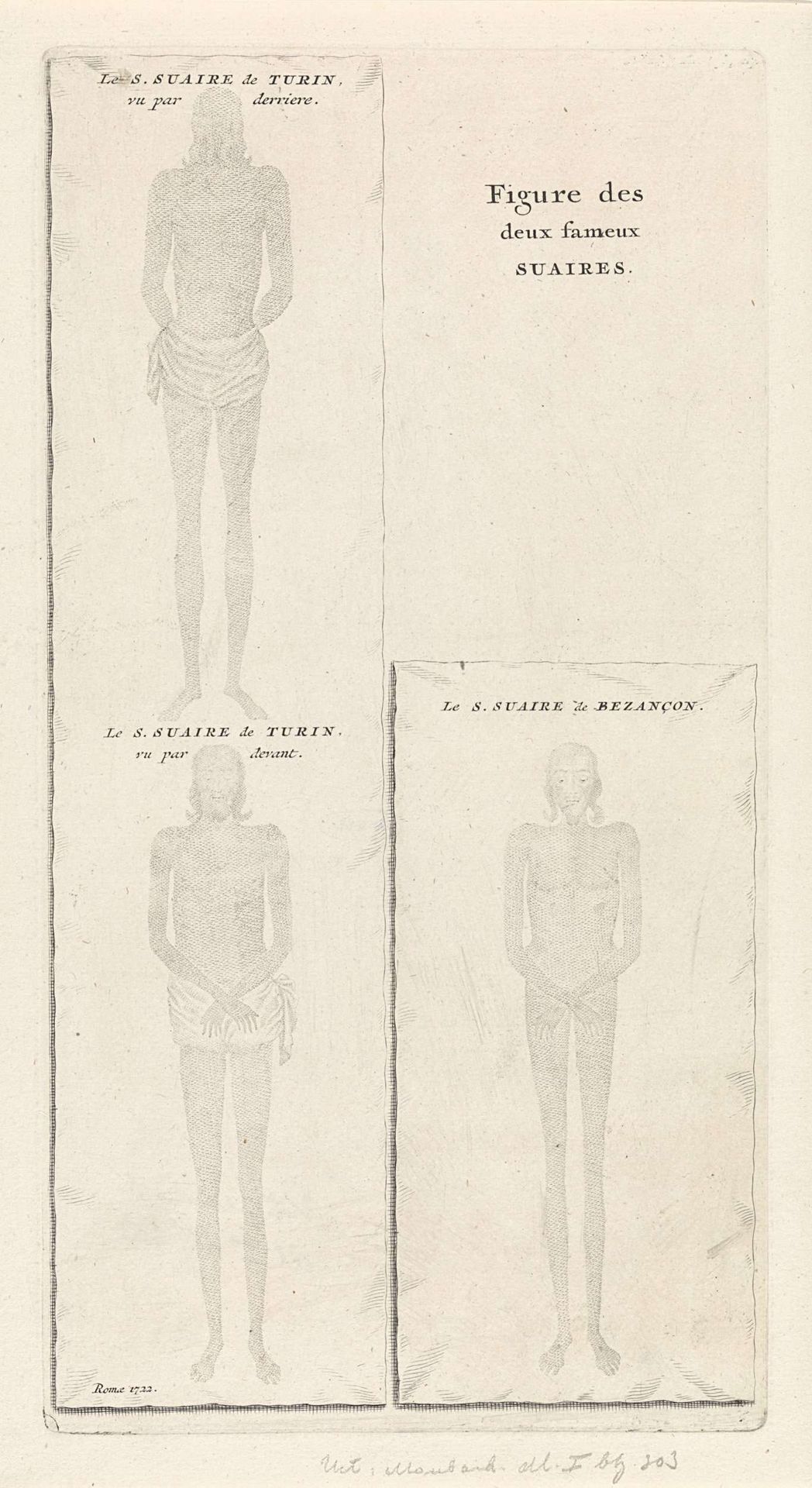
Lijkwade van Turijn en de lijkwade van Besançon

Bernard Picart
1673 - 1733Location
RijksmuseumListen to curator's interpretation
Curatorial notes
Editor: This print from 1723, titled "Lijkwade van Turijn en de lijkwade van Besançon" by Bernard Picart, depicts, as the title suggests, the Shroud of Turin and the Shroud of Besançon. It's haunting—these faded, ghostly figures rendered in delicate lines. I’m immediately curious about why these shrouds were paired together. How do you interpret this work, considering its historical and cultural context? Curator: The pairing is particularly potent, isn’t it? Consider what a shroud represents: not just death, but the lingering trace of a sacred life, a moment frozen in fabric. Picart, by juxtaposing these two relics, is inviting us to compare and perhaps even question their respective claims. Each shroud, through its purported origin and unique imagery, becomes a powerful symbol of faith and belief. Editor: So, it’s about the symbolic power that objects acquire through belief and cultural memory. Is there a significance to their arrangement? Curator: Absolutely. The orientation, the specific rendering of each figure… it all contributes. Think about the visual language employed: The details are faint, almost ephemeral, which itself evokes the passage of time and the fragile nature of memory. What psychological weight do these ghostly impressions carry for the viewer? Editor: That makes me think about how much of the power of an icon comes from not just what it shows, but from what it *implies*. What we project onto it, almost like a Rorschach test for belief. Curator: Precisely! It is a dialogue between the object, its history, and our own deeply held beliefs. Each viewing reshapes the narrative. Editor: I hadn't considered the active role of the viewer in creating the meaning. Curator: Understanding that interplay unlocks so much of the power that imagery holds over us.