About this artwork
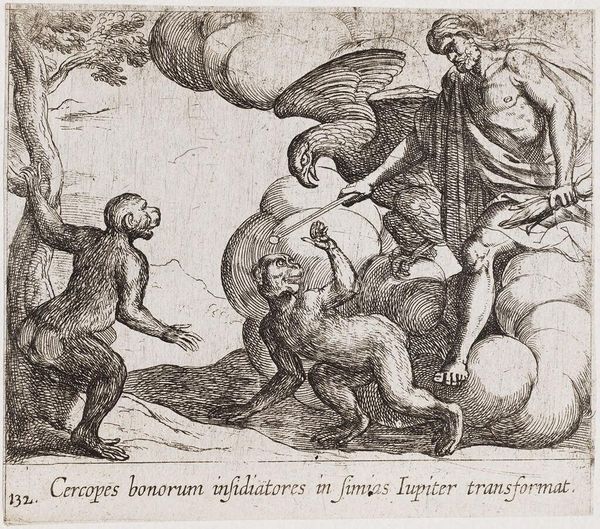
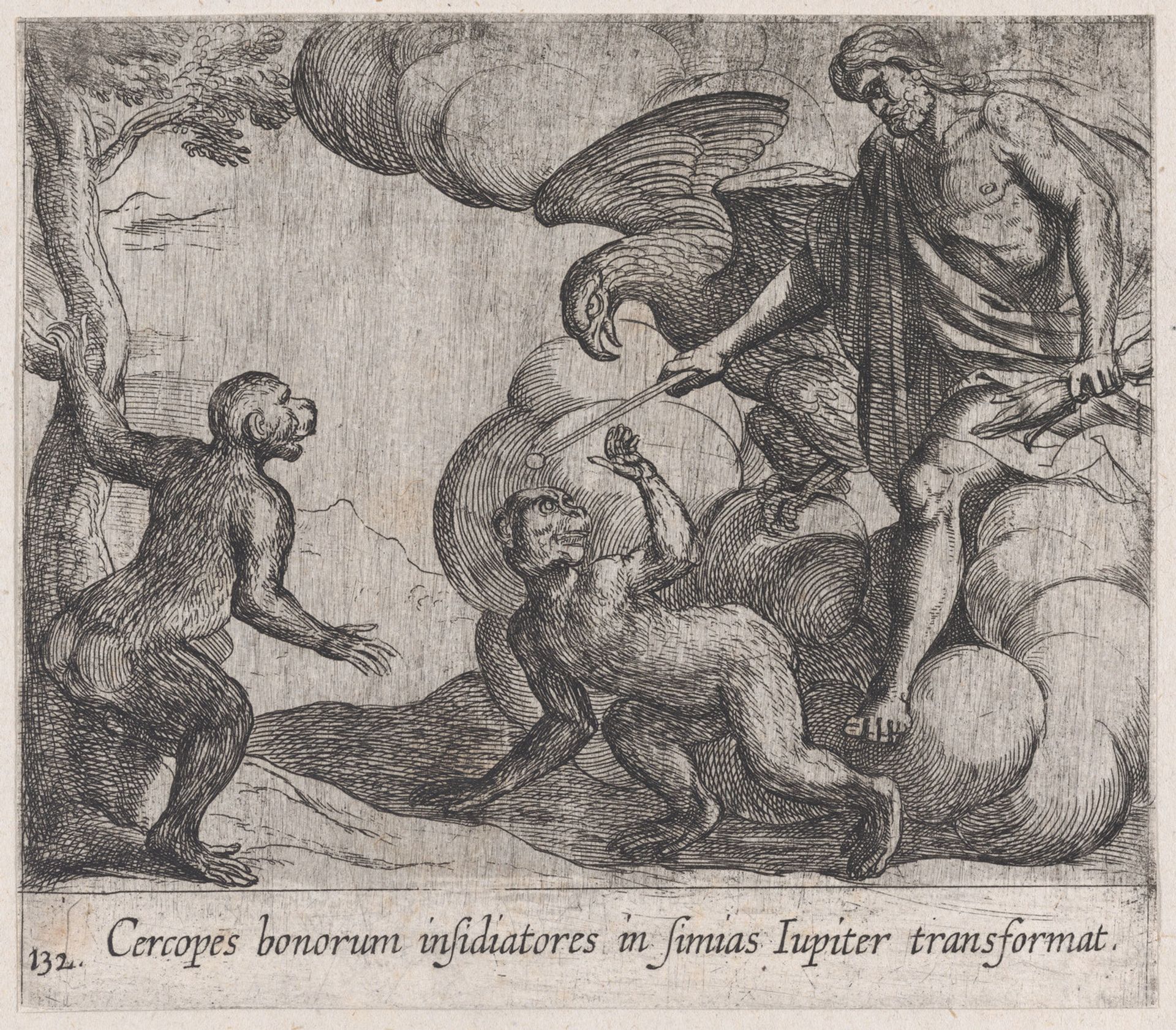
This print, made by Antonio Tempesta, is from his series illustrating Ovid’s Metamorphoses. The medium is etching, a printmaking technique that relies on acid to bite lines into a metal plate. The plate is then inked, and the ink transferred to paper. Look closely, and you’ll see a dense accumulation of these etched lines. Tempesta uses them to describe the transformation of two tricksters into monkeys, as punishment for trying to deceive Jupiter. Notice the way he uses line to create different textures, from the fur of the monkeys, to the clouds Jupiter stands upon. Etching, like engraving, was a reproductive technique. It allowed for the relatively quick and inexpensive distribution of images, so stories like Ovid’s could become widely known. There is a direct relationship between the medium, and the imperative to disseminate classical knowledge as broadly as possible. This print, therefore, is not only an artwork in its own right, but also an artifact of cultural transmission.
Plate 132: Jupiter Changing the Cercopians into Monkeys (Cercopes bonorum insidiatores in Simias Iupiter transformat), from Ovid's 'Metamorphoses'
1606


Artwork details
- Medium
- drawing, print, engraving
- Dimensions
- Sheet: 4 in. × 4 1/2 in. (10.2 × 11.5 cm)
- Location
- Metropolitan Museum of Art, New York, NY
- Copyright
- Public Domain
Tags
Comments
Share your thoughts
About this artwork
This print, made by Antonio Tempesta, is from his series illustrating Ovid’s Metamorphoses. The medium is etching, a printmaking technique that relies on acid to bite lines into a metal plate. The plate is then inked, and the ink transferred to paper. Look closely, and you’ll see a dense accumulation of these etched lines. Tempesta uses them to describe the transformation of two tricksters into monkeys, as punishment for trying to deceive Jupiter. Notice the way he uses line to create different textures, from the fur of the monkeys, to the clouds Jupiter stands upon. Etching, like engraving, was a reproductive technique. It allowed for the relatively quick and inexpensive distribution of images, so stories like Ovid’s could become widely known. There is a direct relationship between the medium, and the imperative to disseminate classical knowledge as broadly as possible. This print, therefore, is not only an artwork in its own right, but also an artifact of cultural transmission.
Comments
Share your thoughts