print, engraving
#
baroque
# print
#
old engraving style
#
figuration
#
genre-painting
#
history-painting
#
engraving
Dimensions: height 325 mm, width 370 mm
Copyright: Rijks Museum: Open Domain
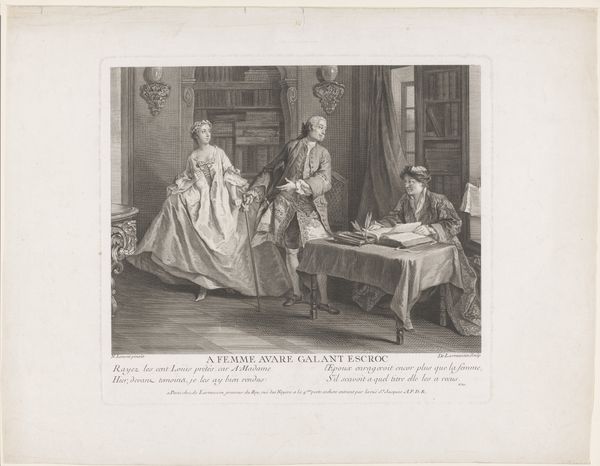
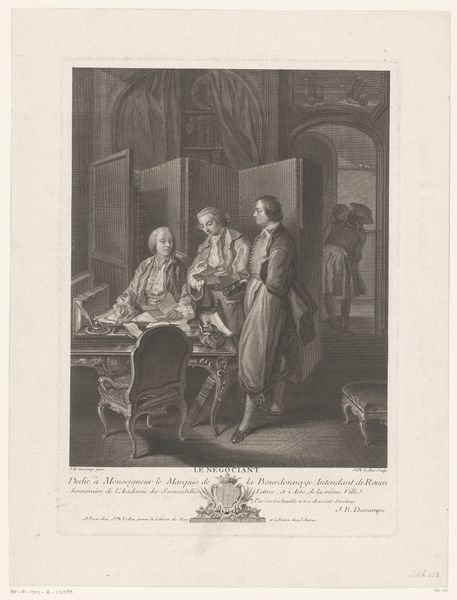
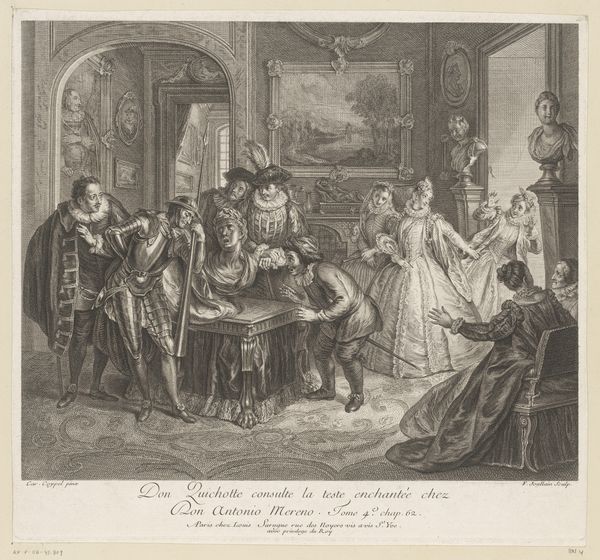
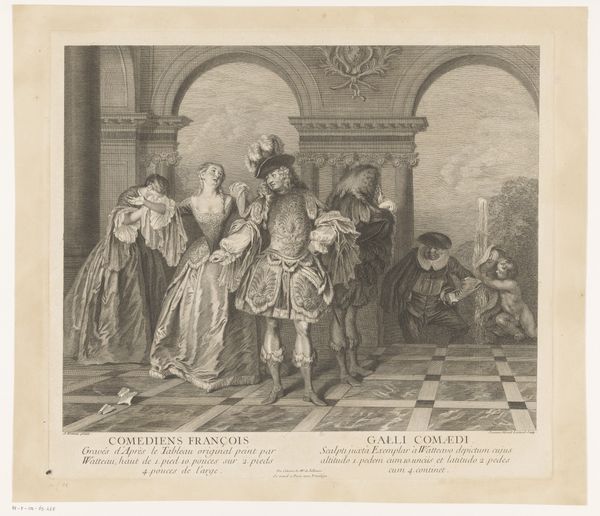
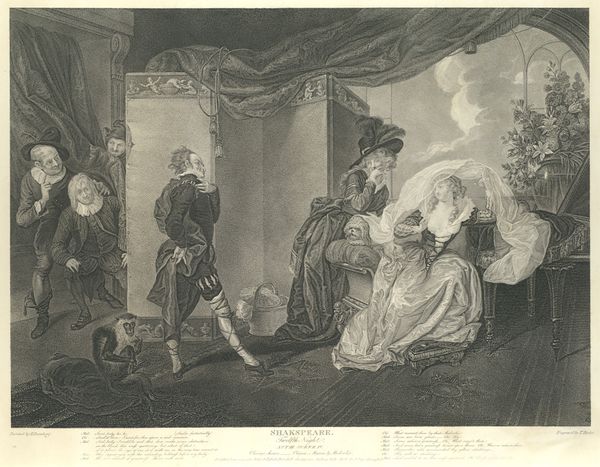
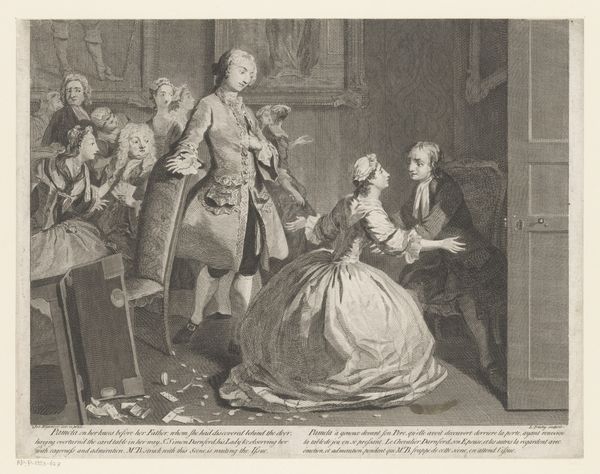
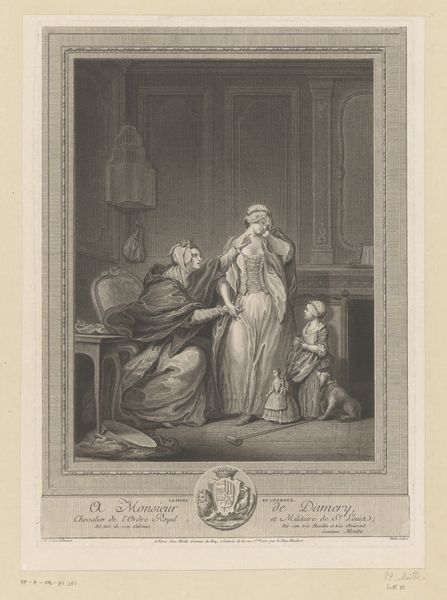
Editor: So, this print is called "Voor een gierige vrouw een schurk als aanbidder," which translates to "For a Greedy Woman, a Rogue as an Admirer," created sometime between 1722 and 1775 by Georg Friedrich Schmidt. It's an engraving, currently held at the Rijksmuseum. It feels very theatrical to me, almost like a stage play. I'm curious, what details stand out to you in this piece? Curator: For me, it's the blatant display of social relations as material exchange that's most compelling. Look at the lines of text, practically a contract laid bare; promises of repayment versus the realities of their potential, or lack thereof. Editor: I see that. You mean the inscription beneath the image? It seems to talk about debts and spouses, or some kind of financial transaction... Curator: Exactly! Schmidt, in choosing engraving as his medium, also reproduces the labor-intensive act of *producing* wealth. The print itself becomes a commodity. The clothing of the figures, the books in the shelves – each element is meticulously rendered to represent status, but simultaneously deconstructs that illusion by reminding us of the labor and materials required for such a performance. Think of the paper itself and the process needed to produce this image. Editor: That's fascinating. I hadn’t considered how the act of creating the print, and its material existence, reflected the themes within the image. So you're suggesting the artwork isn't just depicting a scene, but also embodying the socio-economic realities of its time? Curator: Precisely! The Baroque wasn't just ornament, it was also economy! Editor: I hadn't really thought of it that way. I suppose that analyzing an artwork’s materiality opens up new layers of meaning. Thanks! Curator: And to really understand those meanings you have to see things both as themselves, and the products of labor.
Comments
No comments
Be the first to comment and join the conversation on the ultimate creative platform.
 Collect
 React
React Comment
More like this