Agrippine Landing at Brundisium with the Ashes of Germanicus 1768
0:00
0:00

benjaminwest
Yale University Art Gallery (Yale University), New Haven, CT, US
Dimensions: 163.8 x 240 cm
Copyright: Public domain
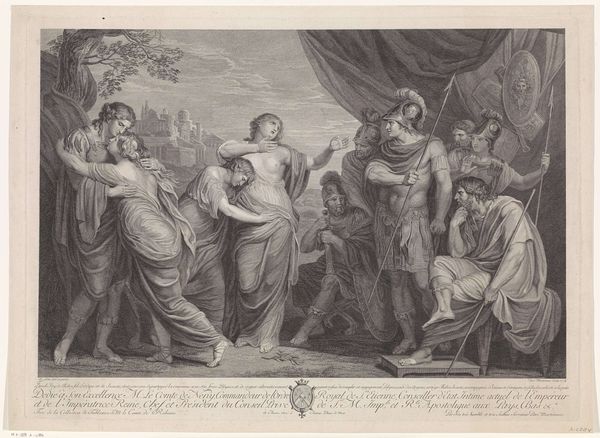
Curator: Standing before us is Benjamin West’s “Agrippine Landing at Brundisium with the Ashes of Germanicus,” painted in 1768. It’s a history painting currently housed in the Yale University Art Gallery. Editor: My first impression is one of restrained grief. Everyone is so still, even the apparent chaos of the setting is subdued. Curator: Precisely. West is depicting a specific moment in Roman history – the arrival of Agrippina, wife of the deceased general Germanicus, bearing his ashes. Consider the painting within the context of the burgeoning Neoclassical movement and the fashion for history painting, a style which carried moral weight, reminding viewers of civic duty. Editor: It's certainly laden with symbols. Agrippina's white garments immediately evoke mourning, while the urn she carries—obviously containing Germanicus’ ashes—transforms her into the embodiment of sorrow and Roman virtue. Notice how the artist has centered her to emphasize these associations. Curator: And let's not forget the other figures: The soldiers in their Roman attire. These figures contribute to the public and political narrative West constructs, alluding to themes of leadership and remembrance during the 18th century when national identities were being defined and debated through art. Editor: The gesture of the Roman pointing away seems loaded with implication as well – is he acknowledging Agrippina, or is he attempting to draw the eye of those onshore. We, as observers, are left to make the emotional leap and come to the appropriate conclusions. Curator: Absolutely. It's a commentary, as much as it is a historical record. Think about how paintings like this were exhibited at the time: publicly displayed in places like the Royal Academy, shaping public sentiment. There's a lot to unpack about the power dynamics within the Roman Empire being visually laid out, reflecting contemporary concerns about empire and governance. Editor: Considering West's skill at merging historical events and emotional display, one truly grasps how artworks like this shaped not only artistic but political thought in its time. Curator: Indeed. Examining its historical context reveals a potent interplay between the aesthetic, moral and political facets of 18th-century European art.
Comments
No comments
Be the first to comment and join the conversation on the ultimate creative platform.
 Collect
 React
React Comment
More like this