


Curatorial notes
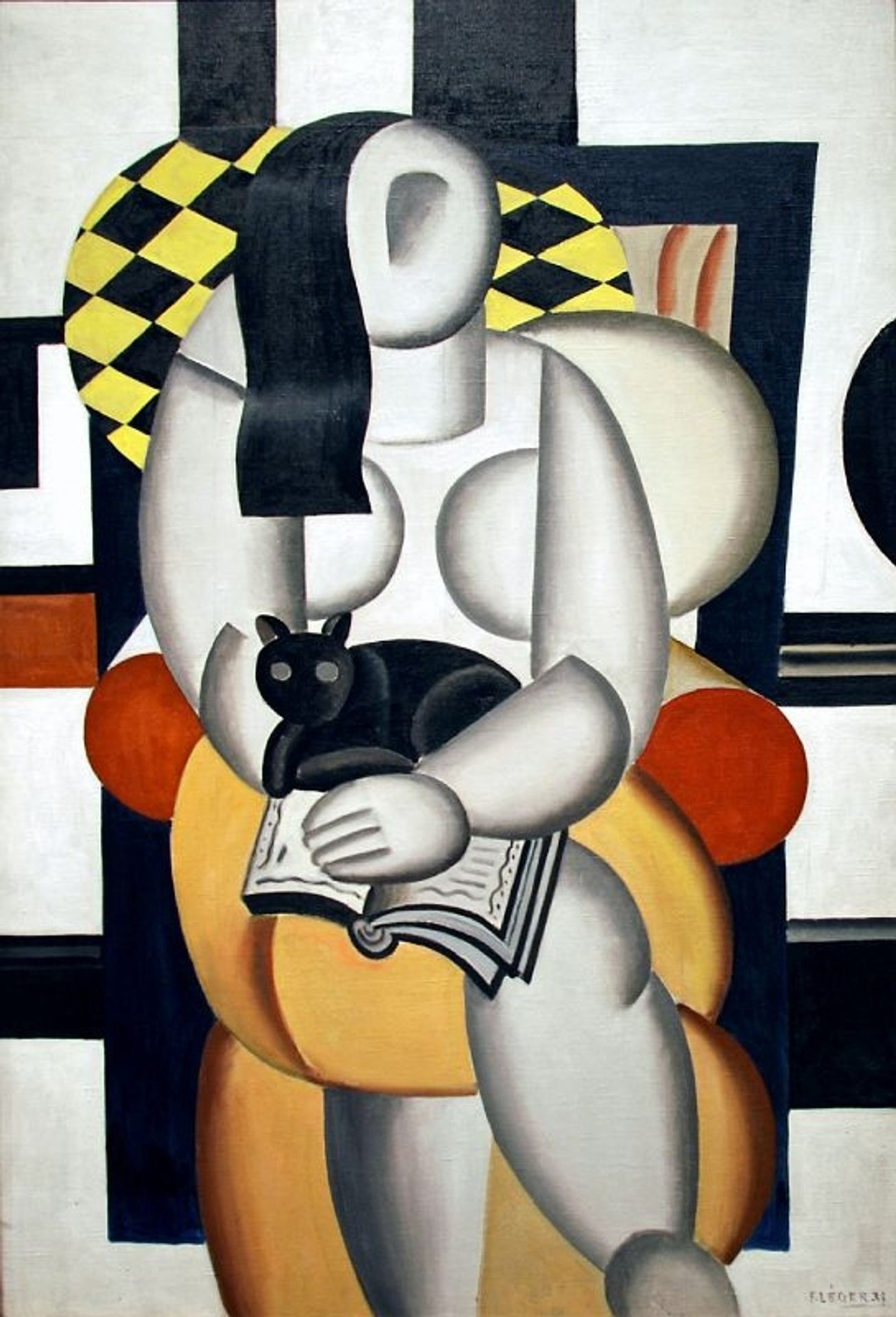
Editor: This is Fernand Léger's "Woman with a Cat" from 1921, done with oil paint. I'm struck by how he renders the figure as a collection of geometric forms; it's very modern, but feels strangely detached, almost robotic. What do you see in this piece? Curator: I see a challenge to conventional representations of women, emerging in the post-World War I era. Léger, like many artists of his time, was grappling with a rapidly changing society and questioning traditional power structures. The reduced forms and almost mechanical rendering of the woman could be read as a commentary on the industrialization and dehumanization he witnessed. Does the contrast of the soft curves of the woman's body and the rigid geometric shapes draw your eye? Editor: Absolutely. It's like he's taking apart the familiar image of a woman and putting it back together in a new, unsettling way. What about the cat? Does that carry any symbolic weight here? Curator: Consider the role of pets as companions, particularly for women. The cat offers a sense of domesticity and perhaps challenges the dominant masculine, modernist narrative of the period, inviting viewers to reconsider these rigid gender roles and how they were being reinforced through abstraction. Editor: So, it's not just about the aesthetic, but also about a subtle pushback against societal expectations? Curator: Exactly. Léger presents us with a multifaceted exploration of form, gender, and the changing role of women in the 20th century. This pushes back on standard art history by including discussions of political implications within these formal compositions. Editor: I never would have considered that reading of it, that it makes a bigger commentary on how the feminine figure is regarded in society, rather than just as a woman with her cat. Curator: These types of artistic decisions can speak volumes about an artist's values. That is the value of reading art through an intersectional lens; what previously seemed obscure can become incredibly insightful.