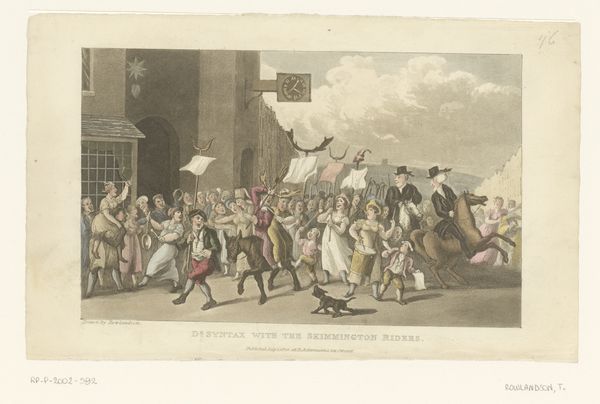
Doctor Syntax Visits a Boarding School for Young Ladies 1820
0:00
0:00


aquatint, hand-colored-etching, print, etching
#
aquatint
#
hand-colored-etching
#
narrative-art
# print
#
etching
#
caricature
#
figuration
#
romanticism
#
line
#
genre-painting
Dimensions: 5 1/4 x 8 1/8 in. (13.34 x 20.64 cm) (sheet)
Copyright: Public Domain
Editor: Here we have "Doctor Syntax Visits a Boarding School for Young Ladies," a hand-colored etching by Thomas Rowlandson, dating back to 1820. It's hard not to see the satirical nature, particularly in the exaggerated features of Doctor Syntax and the gathered schoolgirls. What do you see in this piece, beyond just the surface level caricature? Curator: Absolutely. It’s essential to dig deeper than the humor. Consider the context: early 19th century, a period of burgeoning middle class and evolving ideas about female education. These boarding schools were not just about academics, they were sites for shaping social and cultural norms. What kind of norms do you think Rowlandson is subtly critiquing here? Editor: Maybe the performative nature of education for young women at the time? The girls all seem very posed and proper. Curator: Exactly! The uniformity, the presentation. Rowlandson seems to question the very purpose of these institutions. Who benefits? What social hierarchies are being reinforced? Look at the composition – Doctor Syntax is elevated, seemingly imparting wisdom, while the girls are arranged for observation. How does that dynamic reflect broader societal power structures of the time? Editor: So you’re saying it's more than just a funny picture. It’s a commentary on the social expectations and constraints placed on women in that era? Curator: Precisely! Think about the role of art as a form of social critique. Rowlandson uses caricature not just for laughs, but to expose the absurdities and inequalities baked into the system. The artist implicates the viewer, challenging them to question these norms. Editor: That's a powerful perspective. I was so focused on the immediate visual impact that I missed the deeper social commentary. Curator: It's about learning to read between the lines, understanding the visual language of the time, and connecting the artwork to its historical and social context. Editor: I will definitely look at caricatures differently going forward.
Comments

minneapolisinstituteofart over 2 years ago
⋮
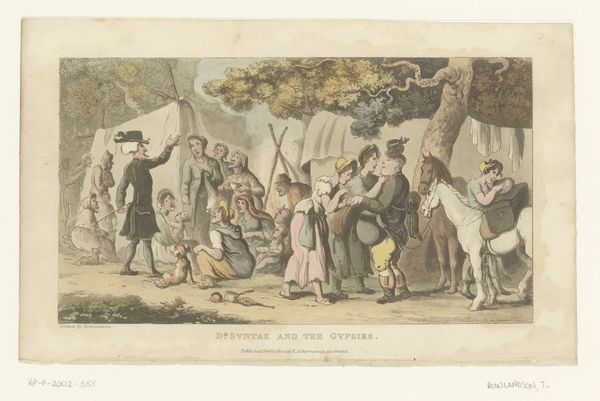
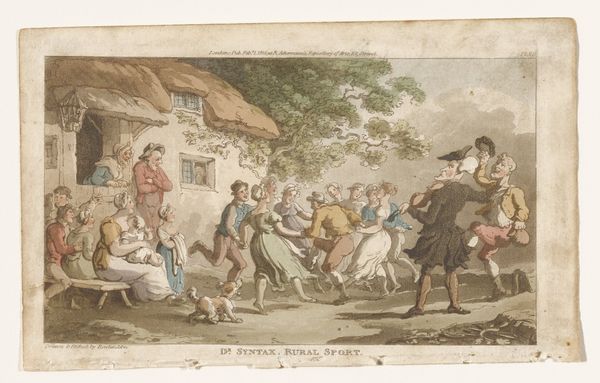
Rowlandson's Doctor Syntax The Tours of Doctor Syntax was an immensely successful series; Rowlandson produced the pictures, which were made into a story by the author William Coombe, who wrote poems to accompany them. Three satirical books were published (1809-21) that follow the hilarious misadventures of a foolish clergyman and schoolmaster, Dr. Syntax, a kind of English Don Quixote. The absurdity of Syntax's character and mishaps incisively mock the customs of the day. Rowlandson devoted most of his time to magazine and book illustration in the second-half of his career, working primarily for the enterprising publisher, Rudolph Ackermann (1764-1834), who printed the Doctor Syntax series. Rowlandson's later activities mark a gradual shift in the caricature genre, when publishers and artists moved away from the production of single, high-quality, expensive prints to the cheaper comical cartoons that were featured in widely distributed magazines. Weeklies like Punch and the Illuminated Magazine were founded in the 1840s and would become a staple of Victorian England. Caricature in this new era served more frequently as illustrated journalism, with cartoons representing an editorial point-of-view, often produced by professional illustrators hired by magazines.


Join the conversation
Join millions of artists and users on Artera today and experience the ultimate creative platform.
 Collect
More like this