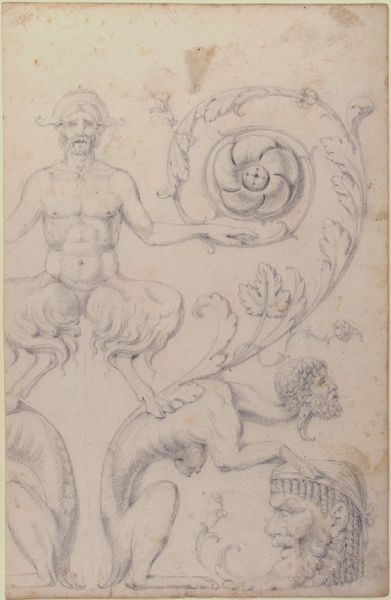
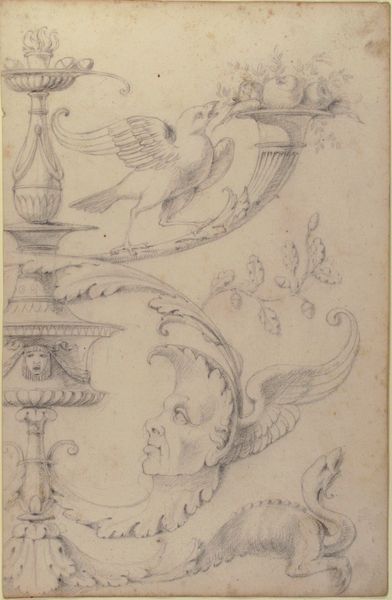
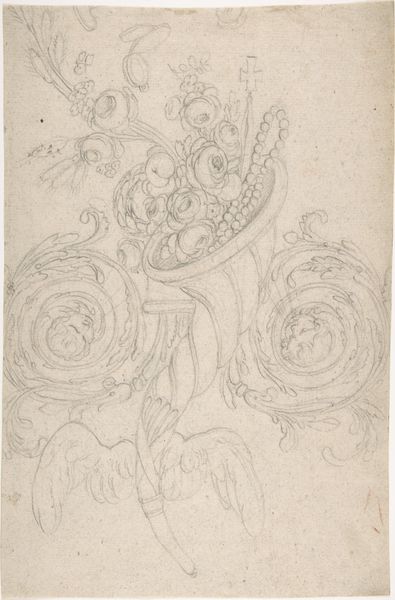
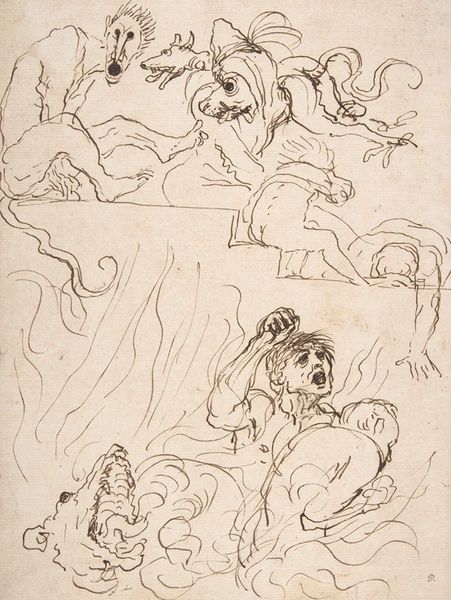
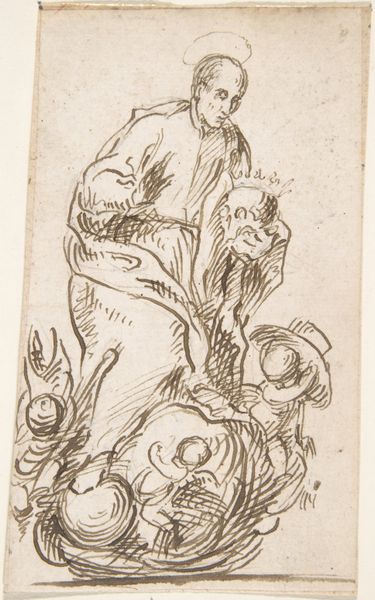
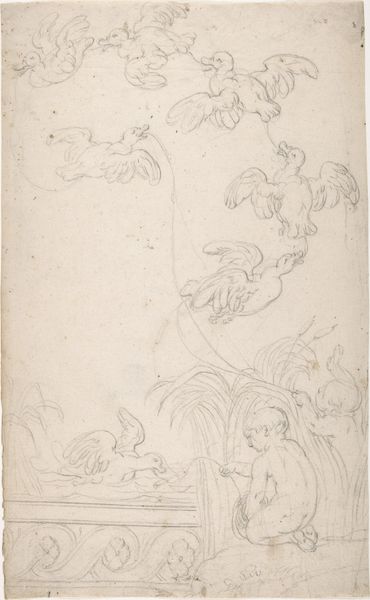
Drawing of a Grotesque after a 16th-century Decorative Relief. 1770 - 1830
0:00
0:00


drawing, ornament, print
#
drawing
#
ornament
#
toned paper
#
light pencil work
# print
#
pencil sketch
#
personal sketchbook
#
ink drawing experimentation
#
men
#
sketchbook drawing
#
pencil work
#
watercolour illustration
#
sketchbook art
#
watercolor
Dimensions: sheet: 13 7/16 x 8 3/4 in. (34.1 x 22.2 cm)
Copyright: Public Domain
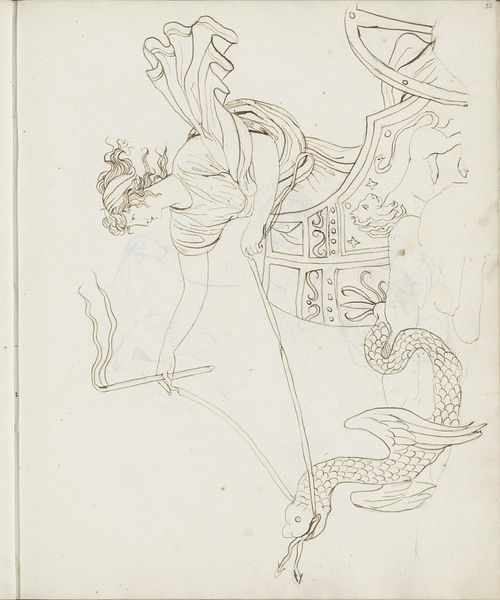
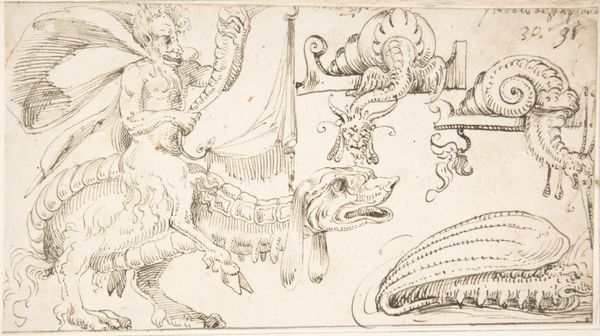
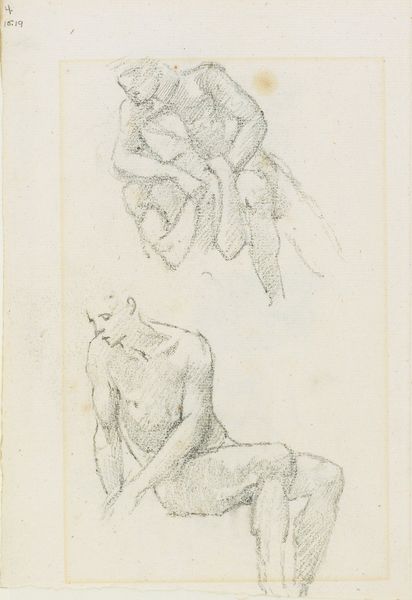
Editor: This is "Drawing of a Grotesque after a 16th-century Decorative Relief," made sometime between 1770 and 1830 by Filippo Cretoni. It's currently held at The Met. I’m struck by the fantastical nature of the figures, like a page torn from someone’s dream journal. What elements stand out to you? Curator: Immediately, I observe the drawing's dependence on line and form. Consider the meticulous hatching and cross-hatching techniques employed to delineate the musculature of the grotesque figures. The tonal gradations, achieved solely through the density of these lines, suggest a remarkable understanding of three-dimensionality. Do you notice the contrast between the crisp outlines of some figures and the softer, more diffused rendering of others? Editor: I do. It seems almost experimental, like Cretoni was trying out different ways to capture the forms. Curator: Precisely. Furthermore, analyze the composition. Note how Cretoni arranges the various motifs—eagle, human figure, fantastical creature—within the picture plane. Their placement isn't haphazard. Observe how the lines create an internal structure, a dialogue between shapes. The drawing showcases a clear visual hierarchy. Is there a mathematical quality that comes to mind when considering the image in its totality? Editor: You're right. There's an intentionality to the whole thing, almost like he was practicing his own technical prowess by copying and varying another artist's designs. I see this exercise now, focusing on structure rather than representation. Curator: Precisely. These sketches allow us to explore his approach to image making. He's captured not just images, but his creative processes too, in a rather sophisticated composition. Editor: Looking at it this way has highlighted the beauty in Cretoni’s rendering techniques and composition and helps me see that the artistry here exists regardless of content. Thank you. Curator: You're welcome. It's by this kind of examination, focusing on forms and structures, that we arrive at meaning through pure sight and reason.
Comments
No comments
Be the first to comment and join the conversation on the ultimate creative platform.
 Collect
 React
React Comment
More like this