About this artwork
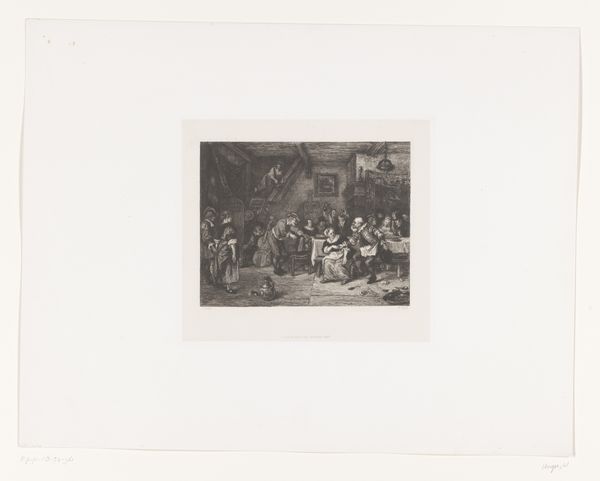
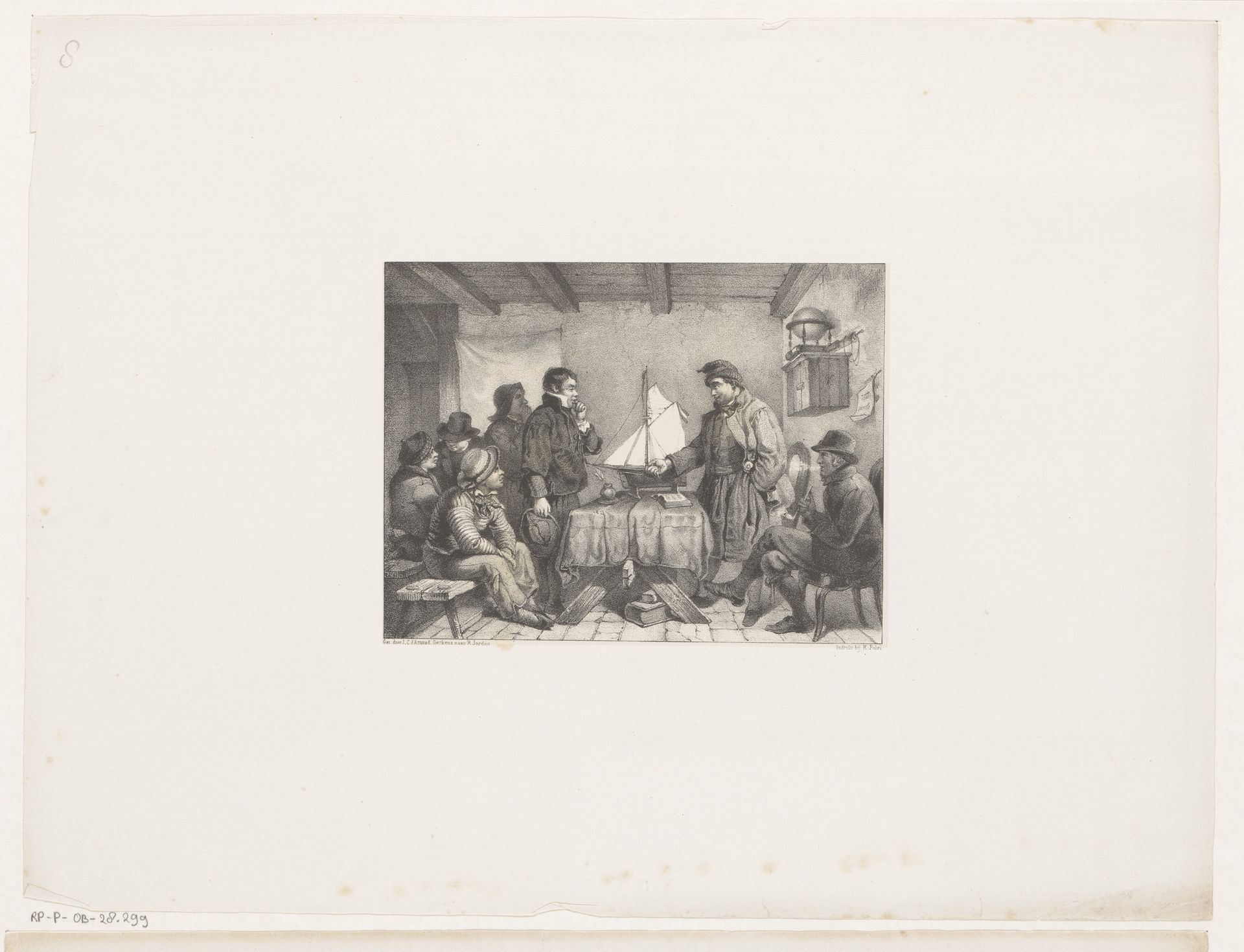
Editor: So, this is “Betaling van de scheepsjongens,” or "Payment of the Cabin Boys," an etching by Johannes Christiaan d' Arnaud Gerkens, made sometime between 1837 and 1853. There's something both intimate and unsettling about it; the cramped space, the solemn faces... what's your take? How do you interpret this work? Curator: I see a stark portrayal of labor and hierarchy. The ship's model at the center immediately makes me think of colonial power and trade. Note the contrast between the figures, their varying ages, and how they're positioned around the table. Who has access to wealth and who is being exploited? Editor: That’s interesting! I hadn’t considered it from a colonial perspective, though the ship obviously suggests travel and trade. Are you suggesting that the 'payment' might be more symbolic of a deeper power dynamic? Curator: Absolutely. Consider the social realities of 19th-century maritime labor. Were these young cabin boys being fairly compensated? Or were they trapped in a system of economic servitude? How might issues of class, age and geographic origin shape each sailor's individual experience of payment and indentured servitude? The artist seems to be inviting us to consider the ethical implications embedded within this seemingly ordinary scene. Editor: That shifts my understanding completely! I initially saw it as a simple genre scene, but you've highlighted its potential for a critique of social inequality. Curator: Art is never truly neutral, is it? It always reflects, reinforces, or challenges the dominant ideologies of its time. What can we learn by exploring historical labor practices and their effect on personal life and culture? Editor: I hadn’t thought of approaching genre scenes this way, viewing art as a form of historical commentary and criticism. I think I’ll look at similar art through a fresh lens now. Curator: Exactly!
Betaling van de scheepsjongens
1837 - 1853

Johannes Christiaan d' Arnaud Gerkens
1823 - 1892Location
RijksmuseumArtwork details
- Medium
- print, etching
- Dimensions
- height 275 mm, width 365 mm
- Location
- Rijksmuseum
- Copyright
- Rijks Museum: Open Domain
Tags
narrative-art
etching
genre-painting
realism
Comments
Be the first to share your thoughts about this work.
About this artwork
Editor: So, this is “Betaling van de scheepsjongens,” or "Payment of the Cabin Boys," an etching by Johannes Christiaan d' Arnaud Gerkens, made sometime between 1837 and 1853. There's something both intimate and unsettling about it; the cramped space, the solemn faces... what's your take? How do you interpret this work? Curator: I see a stark portrayal of labor and hierarchy. The ship's model at the center immediately makes me think of colonial power and trade. Note the contrast between the figures, their varying ages, and how they're positioned around the table. Who has access to wealth and who is being exploited? Editor: That’s interesting! I hadn’t considered it from a colonial perspective, though the ship obviously suggests travel and trade. Are you suggesting that the 'payment' might be more symbolic of a deeper power dynamic? Curator: Absolutely. Consider the social realities of 19th-century maritime labor. Were these young cabin boys being fairly compensated? Or were they trapped in a system of economic servitude? How might issues of class, age and geographic origin shape each sailor's individual experience of payment and indentured servitude? The artist seems to be inviting us to consider the ethical implications embedded within this seemingly ordinary scene. Editor: That shifts my understanding completely! I initially saw it as a simple genre scene, but you've highlighted its potential for a critique of social inequality. Curator: Art is never truly neutral, is it? It always reflects, reinforces, or challenges the dominant ideologies of its time. What can we learn by exploring historical labor practices and their effect on personal life and culture? Editor: I hadn’t thought of approaching genre scenes this way, viewing art as a form of historical commentary and criticism. I think I’ll look at similar art through a fresh lens now. Curator: Exactly!
Comments
Be the first to share your thoughts about this work.