engraving
#
portrait
#
figuration
#
romanticism
#
academic-art
#
engraving
Dimensions: height 462 mm, width 335 mm
Copyright: Rijks Museum: Open Domain
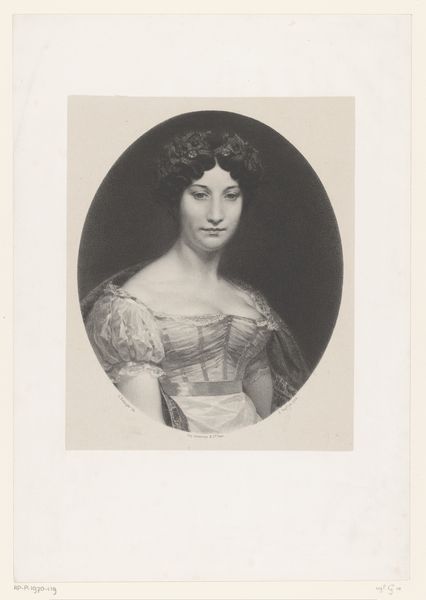
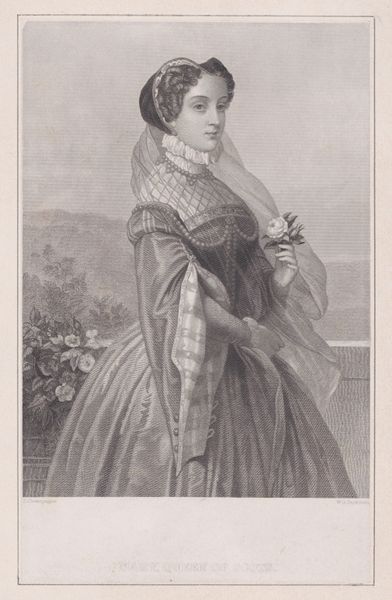
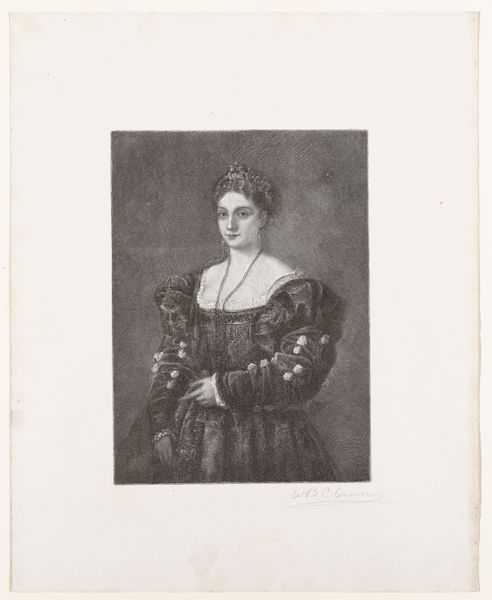
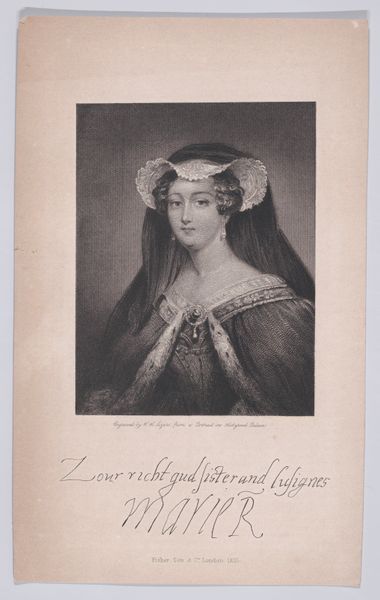
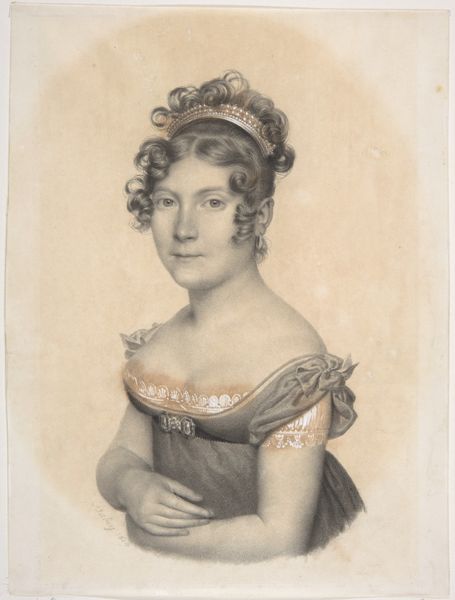
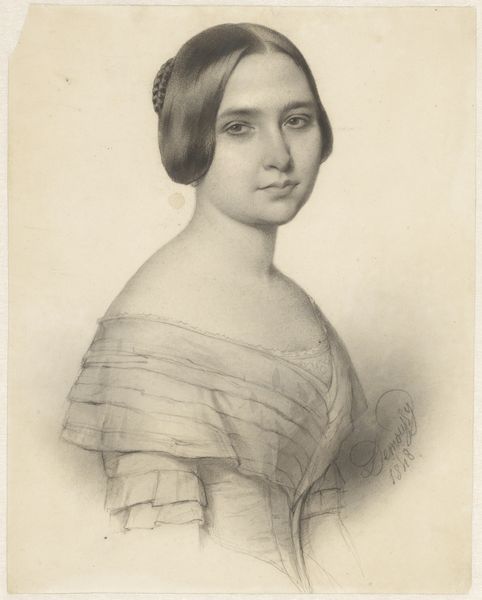
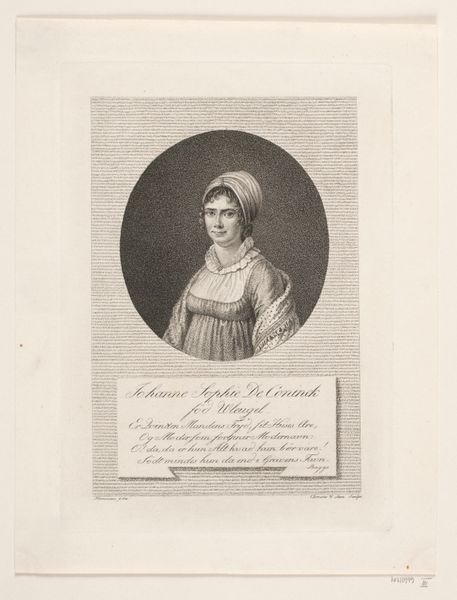
Editor: We're looking at Louis Philibert Debucourt's 1821 engraving, "Buste van een vrouw met hoofddeksel", also known as "La Belle Frascatane". What strikes me most is how…controlled it feels, especially given it's from the Romantic era. The subject's gaze is so direct, the lines are so precise. What do you see in this piece? Curator: I see a carefully constructed interplay of lines and forms. Notice how the verticality of the headdress and lace contrasts with the gentle curve of the subject's face. The textures too, the smoothness of her skin against the complex patterns of her bodice, it is very telling of this piece's academic approach. Editor: So you’re saying the composition itself is a key element? Curator: Absolutely. It's not simply a representation; it's an arrangement. The artist is less interested in conveying raw emotion, which is what you'd expect in the Romanticism period, and more interested in structure, surface. Look at the symmetry; almost perfectly balanced, a classical approach to portraiture. Editor: But isn't Romanticism all about breaking free from those classical structures? Is there anything about it that you consider Romantic? Curator: Perhaps the slightest inclination, expressed through the softness in the grey gradations and in her eyes, as if looking past the viewer towards the unfathomable. We must be weary of simple, reductive category names. Can you suggest any alternatives to describe this artwork? Editor: Maybe a merging of the two – Neo-Classical Romanticism, like it’s trying to marry those sensibilities… The close study of light, shadow and line – I get a much clearer sense of how to approach and think about art. Thank you! Curator: A pleasure to sharpen one's approach to visual analysis, particularly through the deconstruction of aesthetic form and structural reading, instead of blindly focusing on categories.
Comments
No comments
Be the first to comment and join the conversation on the ultimate creative platform.
 Collect
 React
React Comment
More like this