drawing, watercolor, pen
#
portrait
#
drawing
#
water colours
#
baroque
#
dutch-golden-age
#
landscape
#
watercolor
#
coloured pencil
#
pen
#
genre-painting
#
mixed media
#
watercolor
Dimensions: height 243 mm, width 360 mm
Copyright: Rijks Museum: Open Domain
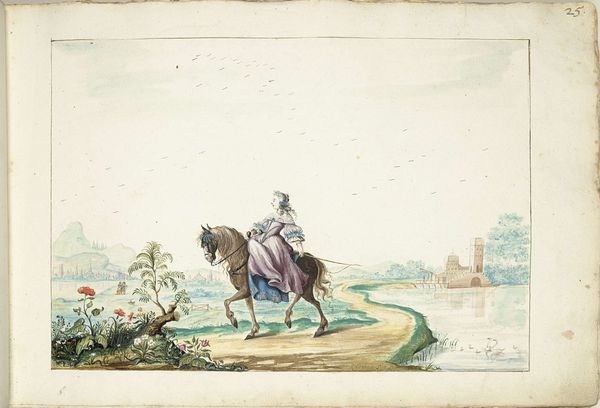
Editor: This is "Man en gemaskerde vrouw te paard" (Man and Masked Woman on Horseback) from 1660, made by Gesina ter Borch. It’s a drawing done with pen, watercolor and other media. I find the scene quite dreamlike, especially with the masked figure. What symbols jump out at you? Curator: The mask, first and foremost. It’s a potent symbol, isn’t it? It conceals, yes, but also transforms. Think of the commedia dell’arte, popular at the time – masks representing stock characters, social commentary delivered with anonymity. Who *are* these figures, truly? Is it playful or suggestive of a clandestine meeting? The couple on horseback evoke themes of journey and social standing, doesn't it? Editor: I didn’t think of commedia dell’arte! What about the setting though? Curator: The landscape itself, idyllic as it appears, speaks to Dutch Golden Age ideals – prosperity, harmony. But observe the contrast: the natural world juxtaposed with that masked figure hints at hidden desires and the contrast between what's public and what's not. This creates a tension that I believe invites the viewer to consider how these tensions, and cultural anxieties, shape social relations in the moment of its production. Editor: So, even a seemingly simple scene is loaded with potential interpretations. It makes you wonder what stories are hidden beneath the surface! Curator: Precisely! And that’s the beauty of symbolism; its layers of meaning invite continuous interrogation. A mask is never just a mask!
Comments
No comments
Be the first to comment and join the conversation on the ultimate creative platform.
 Collect
 React
React Comment
More like this