painting, watercolor
#
portrait
#
painting
#
painted
#
oil painting
#
watercolor
#
orientalism
#
cityscape
#
genre-painting
Copyright: Public domain
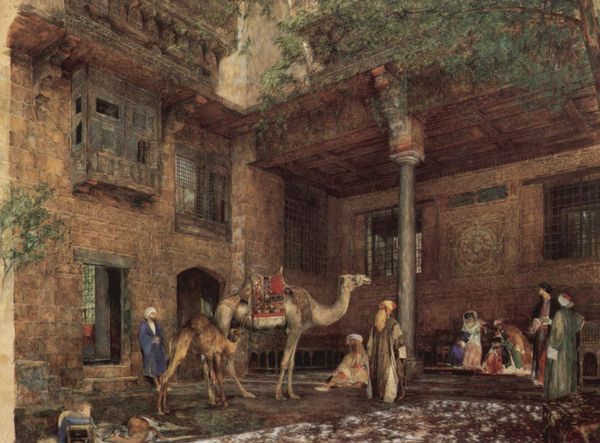
Editor: Here we have John Frederick Lewis's "Stamboul Bazaar," created around 1840 using watercolor and oil. The scene pulses with a bustling energy, yet the colour palette feels subdued, almost muted. What compositional elements stand out to you, and how do they guide your interpretation of this marketplace? Curator: Initially, the structural deployment of light solicits my attention. Note the arched ceiling, a clear architectural element that forms a receding grid pattern. How do you think that use of perspective functions here, especially given the array of figures in the foreground? Editor: I think it creates a sense of depth and draws the eye through the painting, but also traps it; you are looking "in" and deeper, as well. Curator: Precisely. The linear progression enhances depth, framing the subjects but also fragmenting them with those stalls on each side. The watercolor and oil, despite their apparent blending, yield texture contrasts upon closer examination, directing our perception of mass and volume. Are there specific forms that grab your notice? Editor: The arrangement of people, some sitting, some standing or on horses, and then the dense objects around them, form a dynamic equilibrium. Also, look how the clothing is textured, contrasting smooth areas and crumpled drapery that suggest volume and motion! What is the point? Curator: That controlled imbalance creates a focal dynamism. It subtly orchestrates how viewers explore the intricate composition. I feel that Lewis has done much to lead and confuse our sight. The work embodies, through form and materiality, a careful construction rather than pure depiction. That's why I think this remains important art. Editor: This has reshaped how I look at the piece. Focusing on Lewis's methods rather than any potential message clarifies the impact. Thank you for pointing this out. Curator: I agree. Noticing the artist's process truly augments what this represents to both of us.
Comments
No comments
Be the first to comment and join the conversation on the ultimate creative platform.
 Collect
 React
React Comment
More like this