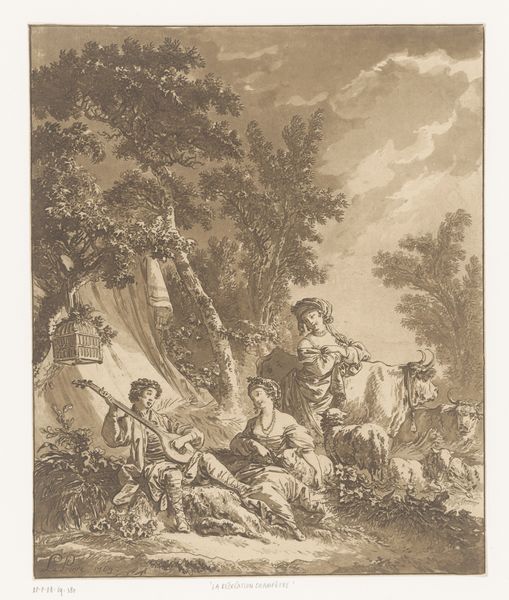
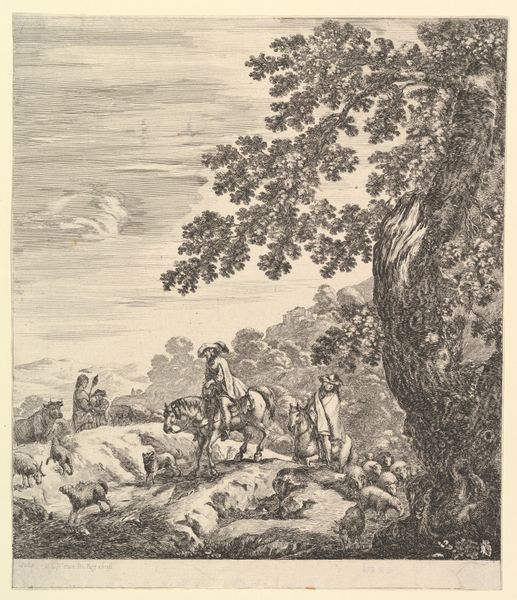
Rustende reizigers met een huis op de achtergrond 1744 - 1816
0:00
0:00

jeancharleslevasseur
Rijksmuseum
Dimensions: height 504 mm, width 376 mm
Copyright: Rijks Museum: Open Domain
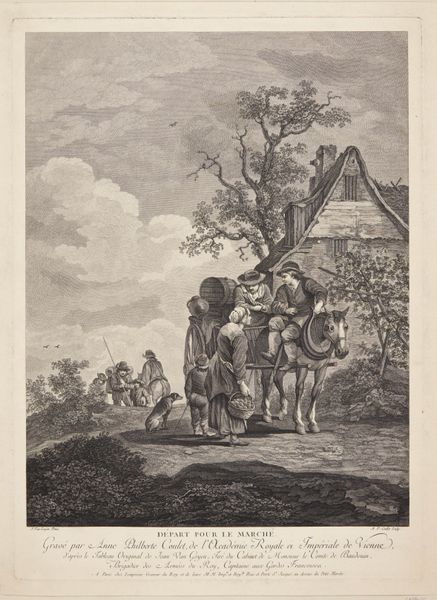
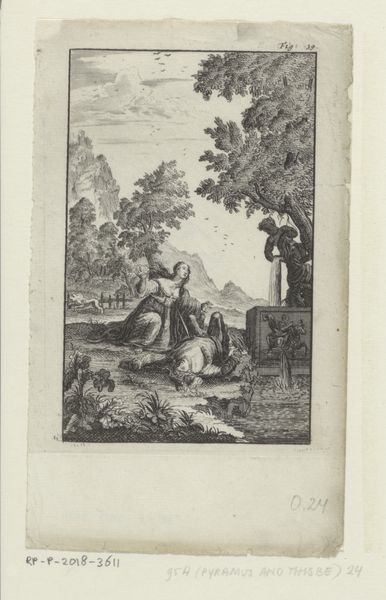
Curator: It has such a lovely pastoral feeling! Editor: Indeed. We're looking at "Resting Travelers with a House in the Background." The Rijksmuseum attributes it to Jean Charles Le Vasseur, made sometime between 1744 and 1816. It's an engraving, one of a matching set. Curator: The line work is remarkable. Just look at the density of marks creating tonal variations – from the light sky to the shadowed copse where the family rests. Considering its context, can you speak about the impact of inexpensive pendant prints and its effects on social classes? Editor: Absolutely. Engravings such as this made imagery accessible and helped popularize Romanticism. Prints could circulate far more widely than paintings and were affordable, extending art consumption across different socio-economic classes. That Romantic style also speaks to a sentimental view of the family and countryside, possibly idealized to ignore rural hardship. Curator: I see that too, a yearning for simplicity represented in a constructed environment. Notice the travelers: are they weary workers seeking a break, or are they rendered for leisurely appeal to their target consumers? This creates some tension around representation and social realities that deserves acknowledgment. The engraving process allows for a detailed portrayal, but ultimately what does that represent and at what social cost? Editor: Well, while Romanticism idealizes rural life, the material reality for most at this time involved harsh labor conditions and land disputes, making rural landscapes more contested terrain. Art becomes less about accuracy and more about representing an ideology or desire, accessible to some but a lived experience for others. The engraver acts as both observer and participant. Curator: And engravers and printers profited from the dissemination of idealized, popular imagery, reinforcing these perceptions in the wider populace, thus influencing fashion and style among their audience. This reinforces Romanticism while changing social perception and potentially misinterpreting working conditions. Editor: I appreciate how highlighting the engraving process underscores both technical achievement and socioeconomic conditions of artistic production during that era. Curator: Thinking about it this way sheds light on production methods, markets and, of course, meanings attached to artistic labor and visual media. Editor: A fruitful exchange, as always!
Comments
No comments
Be the first to comment and join the conversation on the ultimate creative platform.
 Collect
 React
React Comment
More like this