1837
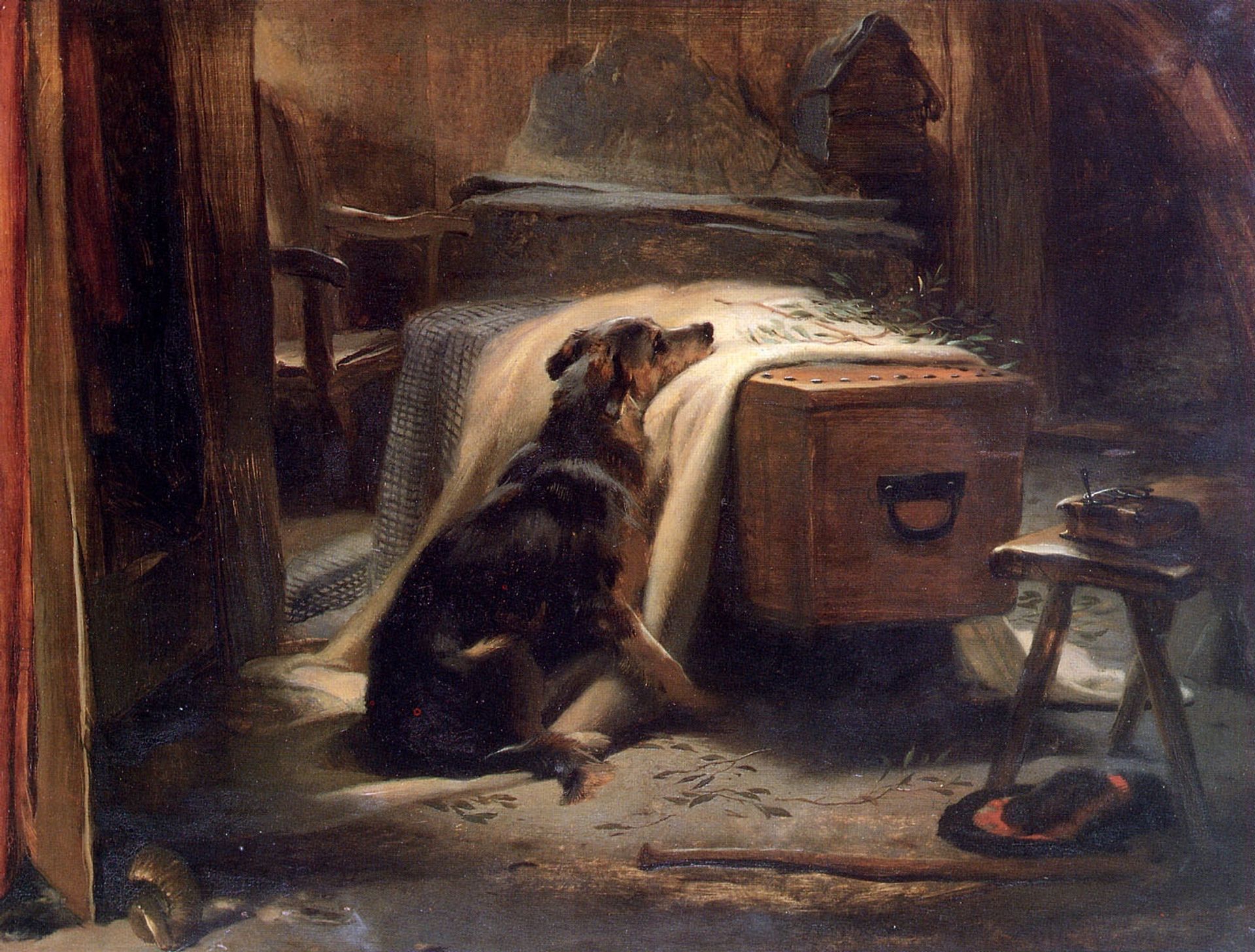
The Old Shepherd's Chief Mourner

Listen to curator's interpretation
Curatorial notes
Editor: So, here we have Landseer's "The Old Shepherd's Chief Mourner" from 1837, done with oil paints. I find it deeply affecting, this real palpable grief. What grabs your attention when you look at this painting? Curator: Ah, yes, a very tender piece, isn't it? I am immediately drawn to the light in the darkness—the beam catching the dog’s fur as he rests his head. It's like a spotlight on unwavering devotion. Don’t you find the objects surrounding the dog are imbued with almost equal weight as the dog? It creates a silent narrative of the shepherd's life—the hat, the pipe, even the worn stool—all witnesses to this shared sorrow. Editor: I hadn't thought about them that way, more just set dressing to confirm the context. Curator: Landseer masterfully elevates the dog beyond a mere animal; he embodies loyalty and profound loss, aspects that resonate universally, doesn't he? In some ways, the way the painting almost theatrically isolates this one moment in this barely-lit stage. And those little details… the scattered leaves suggesting the natural world beyond this room of grief. How does that strike you? Editor: Now that you mention it, I see how the composition pushes me to reflect on mortality. I see in the dog an empathetic stance—something inherently Romantic. Curator: Indeed. It’s as if Landseer asks, "Can you feel what he feels?" A heart-wrenching exploration of the human-animal bond, isn't it? Editor: I see that so clearly now! That relationship feels more complex than it did at first glance. Thanks for that deeper look.