

1874 - 1945
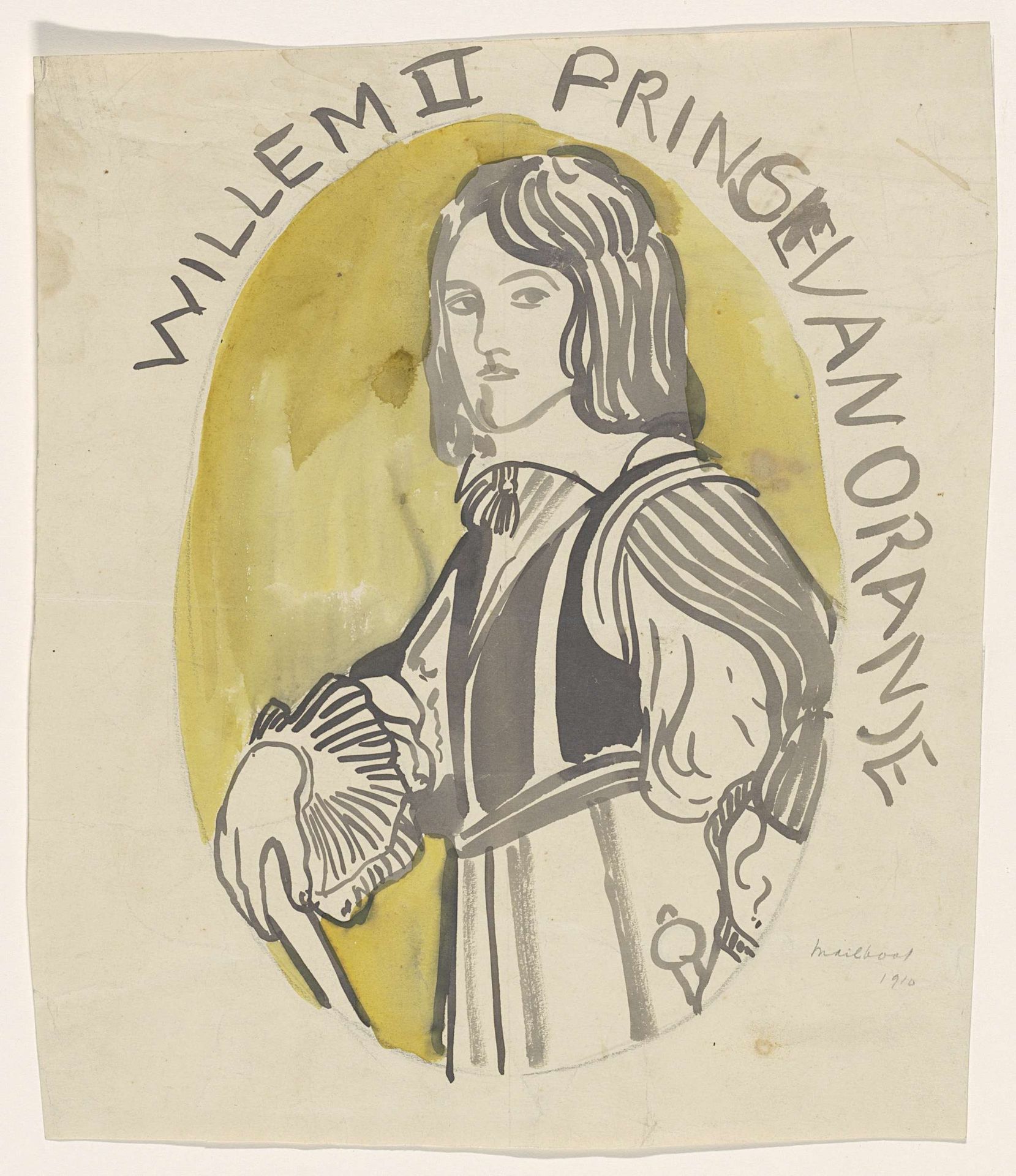
Ontwerp voor een schildering in de Mailboot: Willem II Prins van Oranje

Carel Adolph Lion Cachet
1864 - 1945Location
RijksmuseumListen to curator's interpretation
Curatorial notes
Curator: Carel Adolph Lion Cachet is credited with creating this watercolour drawing entitled "Ontwerp voor een schildering in de Mailboot: Willem II Prins van Oranje", placing its creation somewhere between 1874 and 1945. Editor: My immediate impression is that the tonal range, or perhaps even lack thereof, creates an odd blend of seriousness and levity. There is something almost comical about rendering a regal figure in this manner. Curator: Precisely. Cachet has skillfully rendered this image using an evident economy of line. Observe how his limited palette and rapid strokes produce form and dimensionality. The absence of meticulous detailing pushes the portrait into the realm of caricature, even while it remains recognizable as a royal likeness. Editor: Right. The use of watercolour lends itself to fluidity and translucence, qualities not traditionally associated with formal portraiture. Is Cachet challenging established notions of power and authority by representing Willem II with such informality? Is the semi-circular text a subtle halo of a different sort? Curator: One might also consider how the image's compositional arrangement contributes to the viewer's perception. The loose application of pigment on the background contrasts with the relative crispness of line in the subject. We get that the design serves a purpose beyond the inherent symbolism within. Editor: Let’s think more about symbolism. Consider Willem II as a symbol himself. He represents not just an individual, but a dynasty, an ideal of leadership, and perhaps, even a form of national identity. By depicting him in this casual, almost off-hand style, the artist potentially invites the audience to reconsider these associations. It begs to ask, "What does it really mean to embody such roles or to buy into the imagery around it?" Curator: A semiotic approach is vital in decoding any visual text, including what might seem as a simple drawing. I can observe this as a work that plays with contrasts and explores visual relationships that force viewers to actively question how representation and identity can coincide. Editor: Well, looking at this a certain way provides so much in regard to Cachet's insights into culture. By engaging with images such as this we get access to both their historical context, as well as potential reflections for ourselves today.