About this artwork
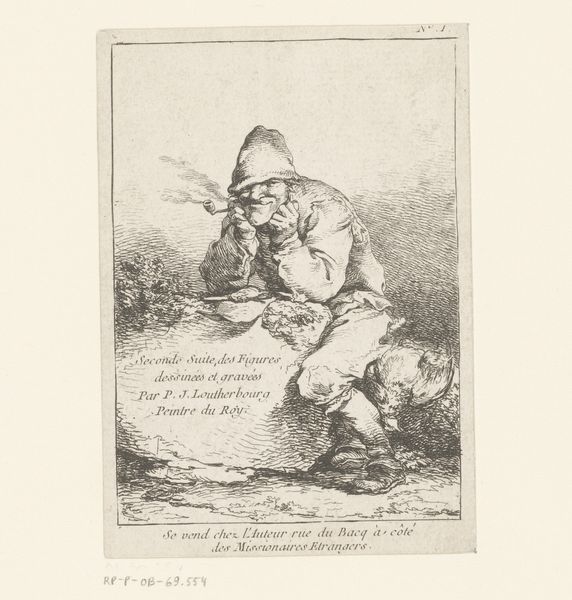
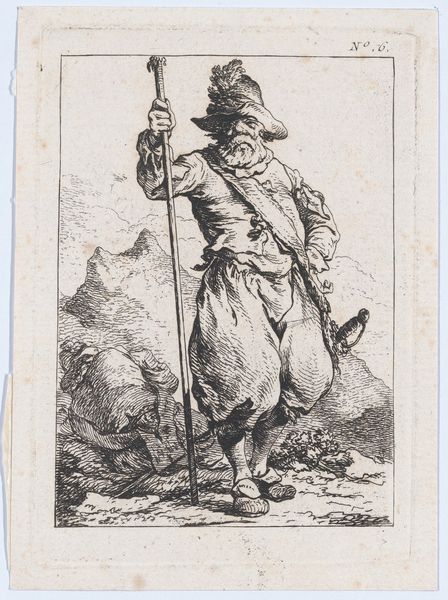
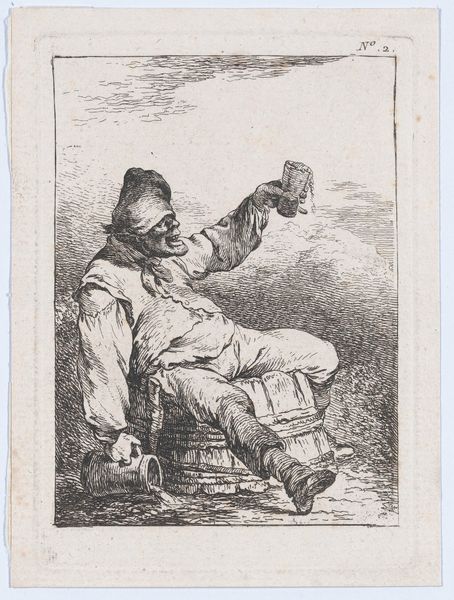
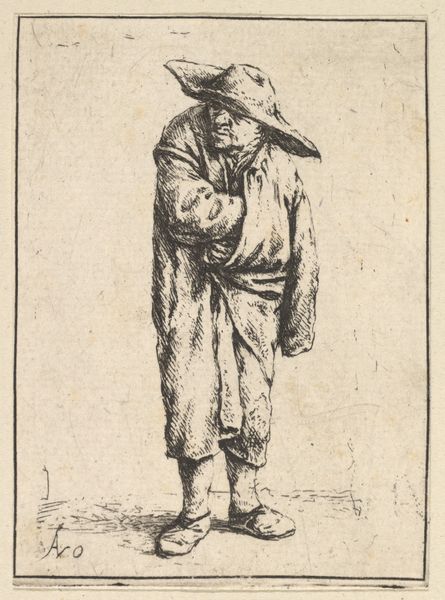
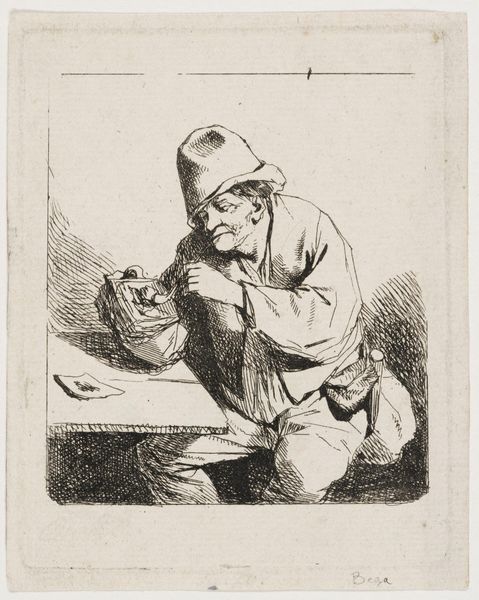
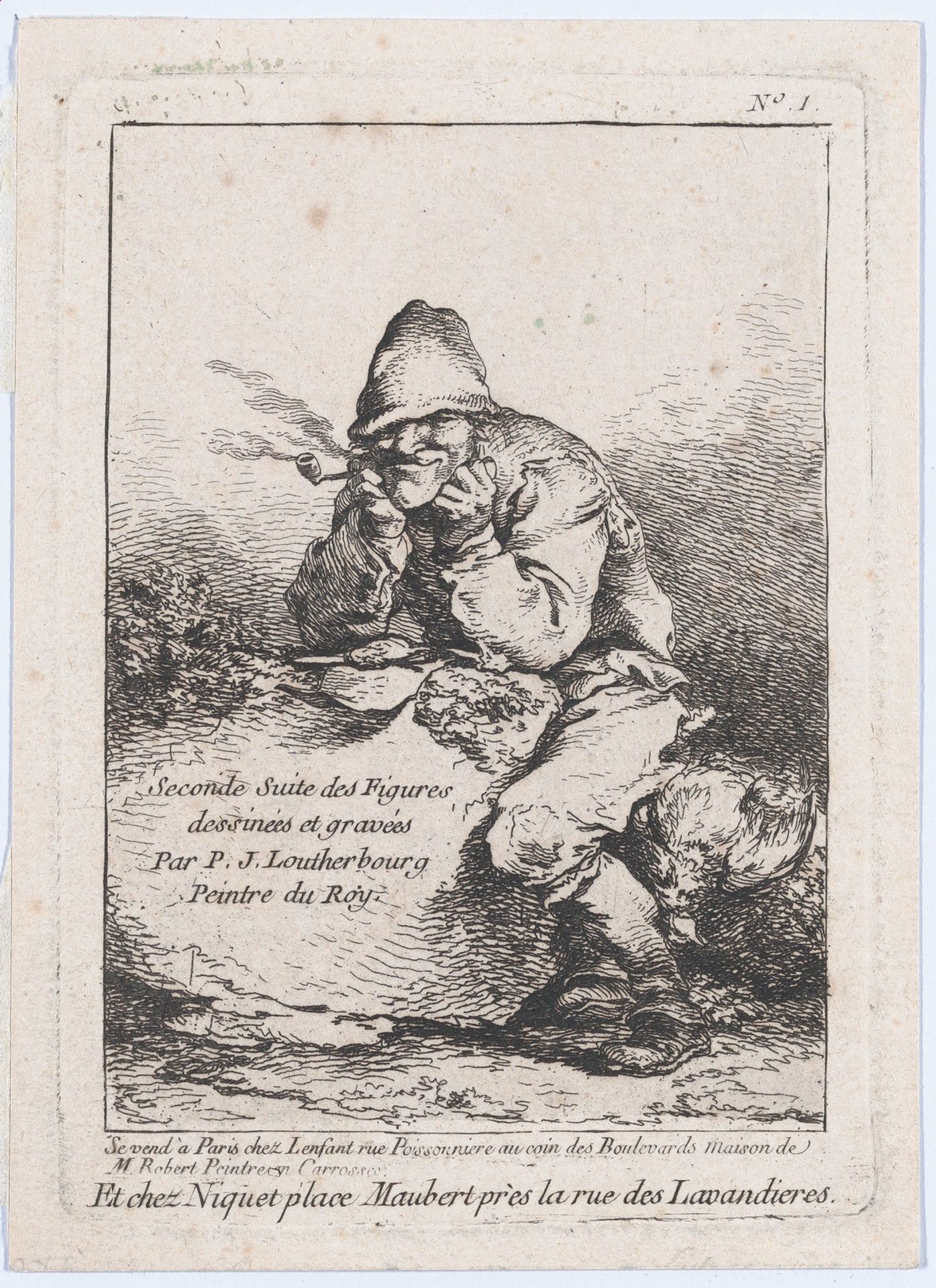
Editor: This engraving, "Seated Man Smoking a Pipe," was created by Philippe Jacques de Loutherbourg sometime between 1755 and 1771. The level of detail achieved with simple lines is striking; however, the portrayal of the figure is a little unsettling, perhaps even satirical. What do you see in this piece? Curator: What strikes me is the pointed nature of this image as it depicts labor, leisure, and class in pre-revolutionary France. Loutherbourg presents us with a member of the working class, but not in labor; instead, he is caught in a moment of repose, an almost defiant act in a society built on rigid social hierarchies. Do you notice how the smoke from the pipe, and the lines of the print, create a sense of enclosure around the man, but also a potential escape? Editor: That's an interesting way to see it. I focused more on the man's clothing and the rough way he's portrayed. The attire seems almost deliberately ragged, marking him as "other." I had considered that perhaps there was a sympathetic connection between artist and model; however, considering that "satirical" might be the appropriate reading given the history? Curator: Exactly! Consider this print in light of burgeoning Enlightenment ideals clashing with aristocratic norms. Is Loutherbourg using this "genre painting" to quietly critique social stratification or to reinforce existing stereotypes? Does his role as "Peintre du Roi"—Painter to the King—complicate his motivations? The act of observation itself is never neutral; even seemingly simple portraits can expose complex power dynamics. Editor: So it becomes a dialogue not just about what is shown, but who is doing the showing, and why. I'm rethinking my initial perception completely. Curator: Precisely. It forces us to question not just the subject, but the entire social and political context in which it was produced. That tension makes it a powerful commentary, wouldn't you agree?
Seated Man Smoking a Pipe
1755 - 1771

Philippe Jacques de Loutherbourg
1740 - 1812
The Metropolitan Museum of Art
Metropolitan Museum of Art, New York, NYArtwork details
- Dimensions
- Sheet: 5 3/16 × 3 3/4 in. (13.2 × 9.5 cm)
- Location
- Metropolitan Museum of Art, New York, NY
- Copyright
- Public Domain
Comments
Share your thoughts
About this artwork
Editor: This engraving, "Seated Man Smoking a Pipe," was created by Philippe Jacques de Loutherbourg sometime between 1755 and 1771. The level of detail achieved with simple lines is striking; however, the portrayal of the figure is a little unsettling, perhaps even satirical. What do you see in this piece? Curator: What strikes me is the pointed nature of this image as it depicts labor, leisure, and class in pre-revolutionary France. Loutherbourg presents us with a member of the working class, but not in labor; instead, he is caught in a moment of repose, an almost defiant act in a society built on rigid social hierarchies. Do you notice how the smoke from the pipe, and the lines of the print, create a sense of enclosure around the man, but also a potential escape? Editor: That's an interesting way to see it. I focused more on the man's clothing and the rough way he's portrayed. The attire seems almost deliberately ragged, marking him as "other." I had considered that perhaps there was a sympathetic connection between artist and model; however, considering that "satirical" might be the appropriate reading given the history? Curator: Exactly! Consider this print in light of burgeoning Enlightenment ideals clashing with aristocratic norms. Is Loutherbourg using this "genre painting" to quietly critique social stratification or to reinforce existing stereotypes? Does his role as "Peintre du Roi"—Painter to the King—complicate his motivations? The act of observation itself is never neutral; even seemingly simple portraits can expose complex power dynamics. Editor: So it becomes a dialogue not just about what is shown, but who is doing the showing, and why. I'm rethinking my initial perception completely. Curator: Precisely. It forces us to question not just the subject, but the entire social and political context in which it was produced. That tension makes it a powerful commentary, wouldn't you agree?
Comments
Share your thoughts