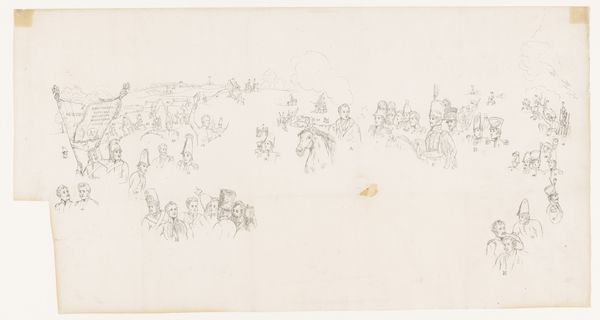
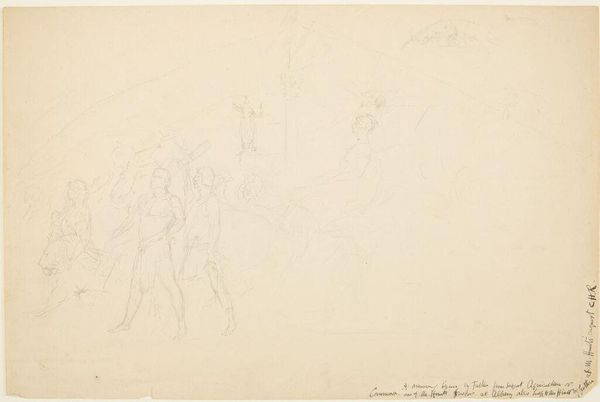
drawing, paper, pencil
#
drawing
#
baroque
#
pencil sketch
#
landscape
#
figuration
#
paper
#
pencil
#
genre-painting
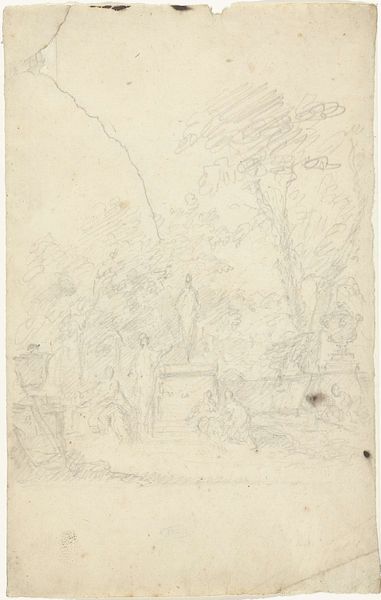
Dimensions: height 330 mm, width 207 mm
Copyright: Rijks Museum: Open Domain
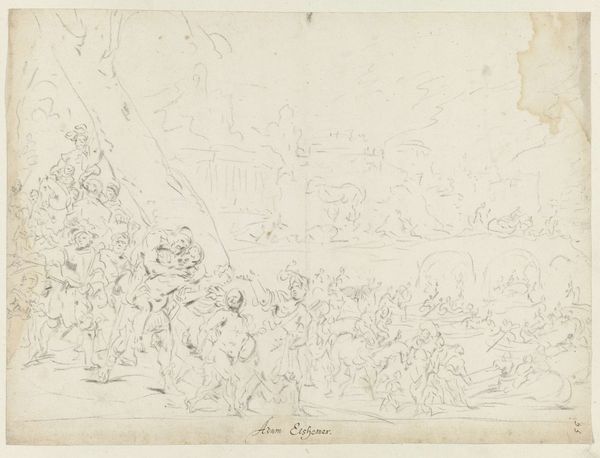
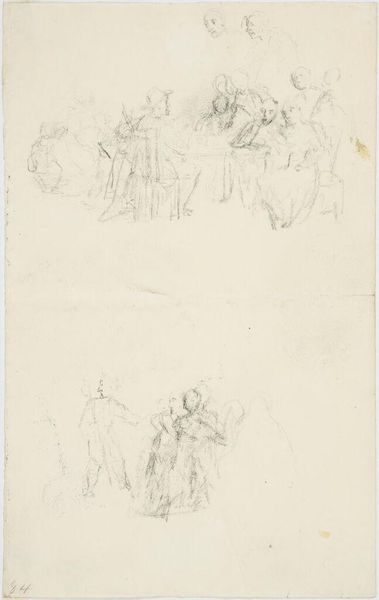
Editor: This is "Personen op een terras bij een standbeeld," or "People on a Terrace Near a Statue," a pencil drawing on paper, made sometime between 1715 and 1798 by Dionys van Nijmegen. It's incredibly faint, a preliminary sketch almost. What catches my eye is how raw the process feels, like seeing the artist think on paper. What can you tell me about it? Curator: Precisely. Let’s consider the social context surrounding drawings like this one. In the 18th century, the availability and cost of materials dictated artistic practices. A quick, inexpensive sketch like this – pencil on paper – speaks to the artist’s initial ideas, the first step in a larger production. Consider the labour involved in producing art materials at this time: the graphite mining, the paper milling. The drawing captures a moment in that entire material process. Editor: So you're saying it’s not just the artist's hand, but also all the hands that prepared the materials? Curator: Exactly. And how readily accessible would these materials be? For whom? These figures are gathered in a leisure setting near statuary. Who would have had access to terraces, statues, leisure time, and art supplies in the 1700s? Editor: Probably the wealthy, the patrons of the arts… This sketch becomes a window into a certain lifestyle dependent on a complex chain of production and consumption. Curator: Indeed. And further, think of the role that drawings such as these would have played in larger art-making enterprises - paintings, prints, tapestries and other reproducible luxury goods available only to elites. This sketch could be a step towards one of those things. Editor: That's fascinating! I hadn't considered how the materiality and production were intertwined with class and consumption like that. Thanks for pointing it out. Curator: My pleasure. Analyzing the material conditions of art production can unlock hidden layers of meaning and connect art to broader social and economic structures.
Comments
No comments
Be the first to comment and join the conversation on the ultimate creative platform.
 Collect
 React
React Comment
More like this